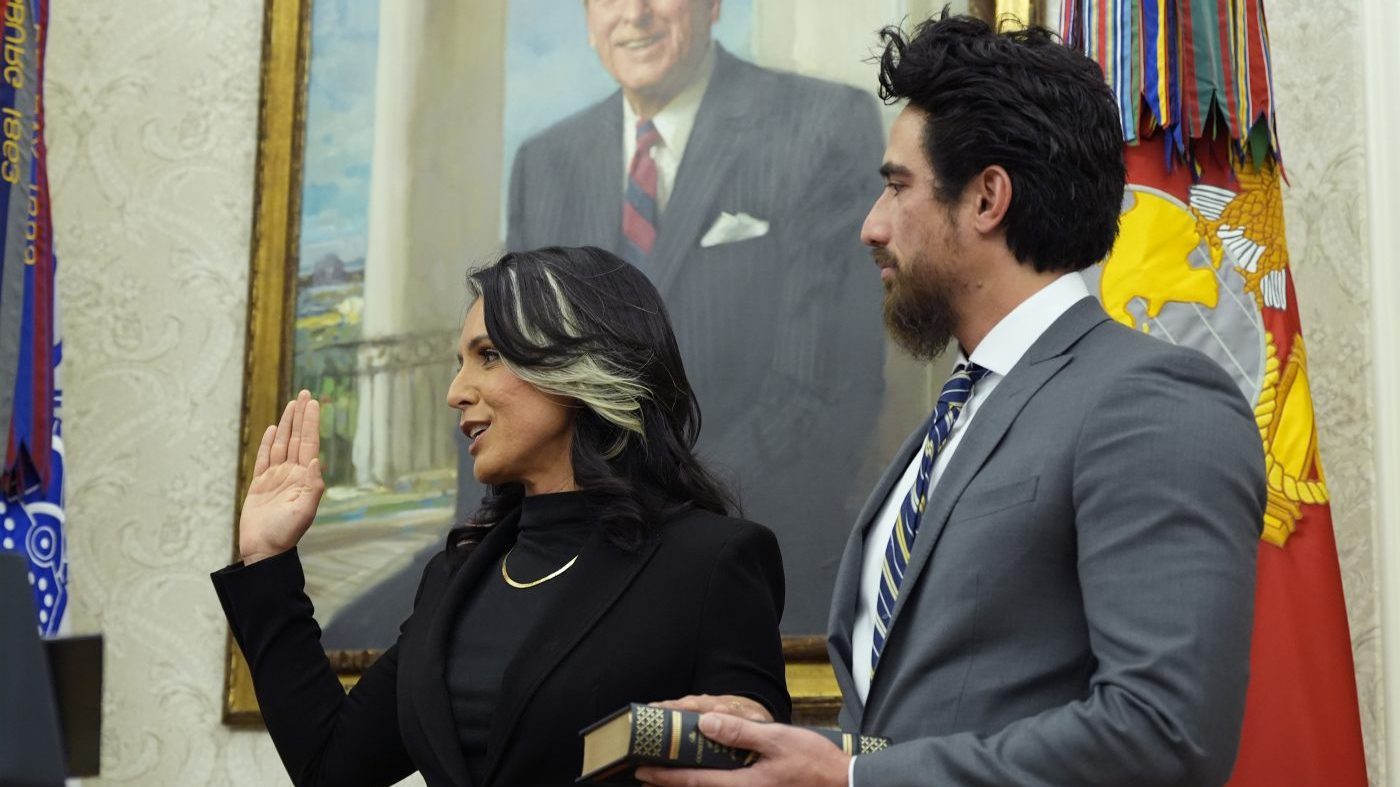
Former Director of National Intelligence Tulsi Gabbard announced that her husband, Abraham Williams, successfully underwent surgery for a rare form of bone cancer, marking a critical step in his treatment after her resignation from the top intelligence post.
In a post on X, Gabbard revealed that Williams was diagnosed with sacral chordoma, a malignant tumor that develops from remnants of the notochord, typically in the spine or skull base. She described the procedure as a nearly seven-hour operation to remove the affected bone and surrounding tissue. 'The surgery ... was successful,' she wrote, adding that Williams experienced significant pain post-operation but is now resting at home. 'Now the recovery begins,' she said, thanking supporters for their prayers and messages.
Gabbard, who previously represented Hawaii in Congress and sought the Democratic presidential nomination in 2020, announced her resignation from the Office of the Director of National Intelligence (ODNI) last month, citing her husband's diagnosis. In a letter to President Trump, she stated that stepping away from public service was necessary to 'be by his side and fully support him through this battle.' She married Williams in 2015, describing him as 'my rock' through her political career, including her departure from the Democratic Party in 2022.
Sacral chordoma is a slow-growing but locally aggressive tumor that is notoriously difficult to treat. According to medical literature from the National Library of Medicine, standard therapy involves wide surgical excision, as the cancer does not respond well to chemotherapy or radiation. The condition is extremely rare, making specialized care critical.
Gabbard's resignation set off a chain of leadership changes at ODNI. Initially, President Trump tapped her deputy, Aaron Lukas, as acting director. However, earlier this week, the president replaced Lukas with William Pulte, the head of the Federal Housing Finance Agency (FHFA). Pulte, a wealthy entrepreneur and Trump donor, has a history of targeting the president's political adversaries, including Federal Reserve Governor Lisa Cook, New York Attorney General Letitia James, and Senator Adam Schiff, with allegations of mortgage fraud.
The appointment of Pulte, who lacks intelligence community experience, drew swift bipartisan criticism on Capitol Hill. Lawmakers voiced concerns that he could use the intelligence apparatus to settle scores against Trump's critics, a move that Schiff has already slammed as Gabbard's 'only positive contribution' being her departure. Some Republicans also questioned the wisdom of placing a political operative at the helm of the nation's intelligence agencies, especially amid ongoing national security threats.
Meanwhile, the leadership vacuum at ODNI has prompted speculation about a permanent successor. Representative Jim Banks has endorsed Elise Stefanik for the role, though no formal nomination has been announced. The controversy surrounding Pulte's interim role has further complicated the transition.
Gabbard's departure marks the end of a brief, tumultuous tenure at ODNI, which she assumed after Trump's return to office. Her resignation letter emphasized her gratitude for the opportunity to serve, but made clear that family comes first. 'His strength and love have sustained me through every challenge,' she wrote. 'I cannot in good conscience ask him to face this fight alone while I continue in this demanding and time-consuming position.'
As Williams begins his recovery, the political fallout from Gabbard's resignation continues to reverberate, with questions lingering about the direction of U.S. intelligence under Trump's second term. For now, Gabbard's focus remains on her husband's health, a reminder of the personal sacrifices that often accompany public service.