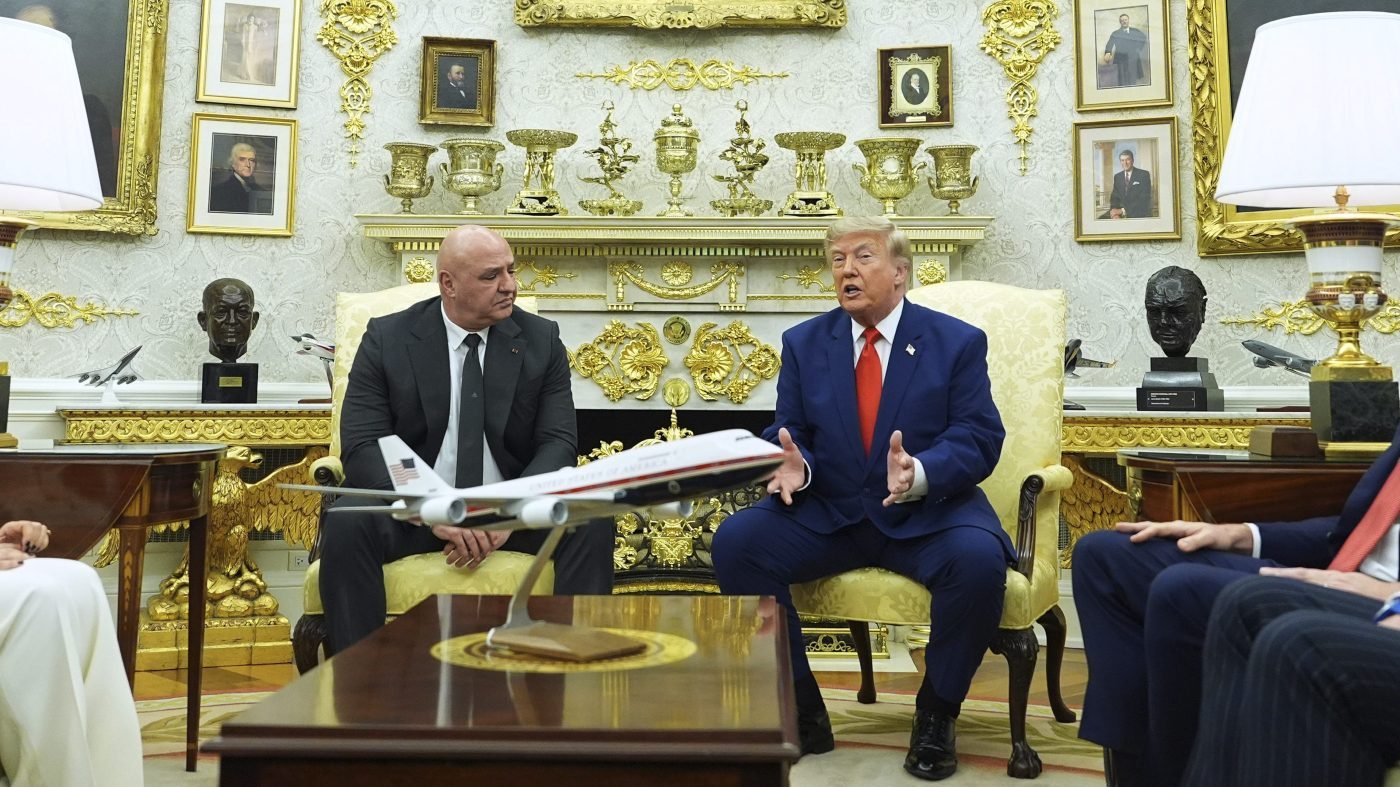
President Donald Trump on Monday warned that the United States would respond militarily if Yemen’s Houthi rebels follow through on their threat to blockade Red Sea shipping and energy exports from Saudi Arabia. Speaking in the Oval Office alongside Lebanese President Joseph Aoun, Trump said, “So far, it hasn’t happened, might happen, but we take care of things.” He added, “If something like that happens, we take care of it. You know, we’ve done that with the Houthis before, and we haven’t heard from them in a while since we did what we did originally.”
The Houthi armed forces announced a “maritime embargo against the criminal Saudi enemy, based on the equation of ‘an eye for an eye,’ effective immediately.” If implemented, the blockade risks unraveling a ceasefire agreement reached in May 2025 between the U.S. and the Houthis, brokered by Oman. That deal halted Houthi attacks on American ships but did not cover Israeli vessels transiting the Bab el-Mandeb strait.
Between March and May 2025, the U.S. conducted a major military campaign against the Iran-backed Houthis, whom Washington has designated as a terrorist group. The Pentagon reported striking over 1,000 targets, killing both fighters and senior leaders, including missile and drone commanders. About 15 percent of global shipping passes through the Red Sea and Gulf of Aden, making the waterway critical to international trade and energy markets.
Trump emphasized the effectiveness of that campaign, saying, “That was about 45 days of very powerful action we took against the Houthis, and we’ve had no problem with the Houthis. They’ve had no problem with us for a long period of time, including during this conflict. I think that if there is something like that, we’ll just have to take care of business.”
The blockade threat comes after a strike on Sanaa airport, which is controlled by the Houthis in northern Yemen. The internationally recognized Yemeni government, based in the south and backed by Saudi Arabia, claimed responsibility. However, the Houthis blamed Saudi Arabia for the attack, which The New York Times reported appeared aimed at preventing an Iranian plane from landing. In retaliation, the Houthis fired at a Saudi airport in Abha.
This escalation adds a new layer to ongoing tensions in the region. Trump’s comments come as his administration continues to navigate a complex web of diplomatic and military challenges, including trade disputes and domestic political battles. For instance, Senator Thune has questioned the administration’s latest tariff escalation against Canada, while House Democrats are holding press conferences to counter Trump’s agenda ahead of the midterms.
The situation also underscores the fragility of the May 2025 ceasefire. If the Houthis enforce the blockade, it could trigger a renewed U.S. military response, potentially drawing in Saudi Arabia and Iran. The White House has not detailed specific next steps, but Trump’s language signals a readiness to act unilaterally if needed.
Analysts note that the Houthi threat is partly a reaction to the Sanaa airport strike and the broader conflict between the Saudi-backed government and the Iran-aligned rebels. The U.S. designation of the Houthis as a terrorist organization complicates any diplomatic resolution, as does the group’s ties to Tehran.