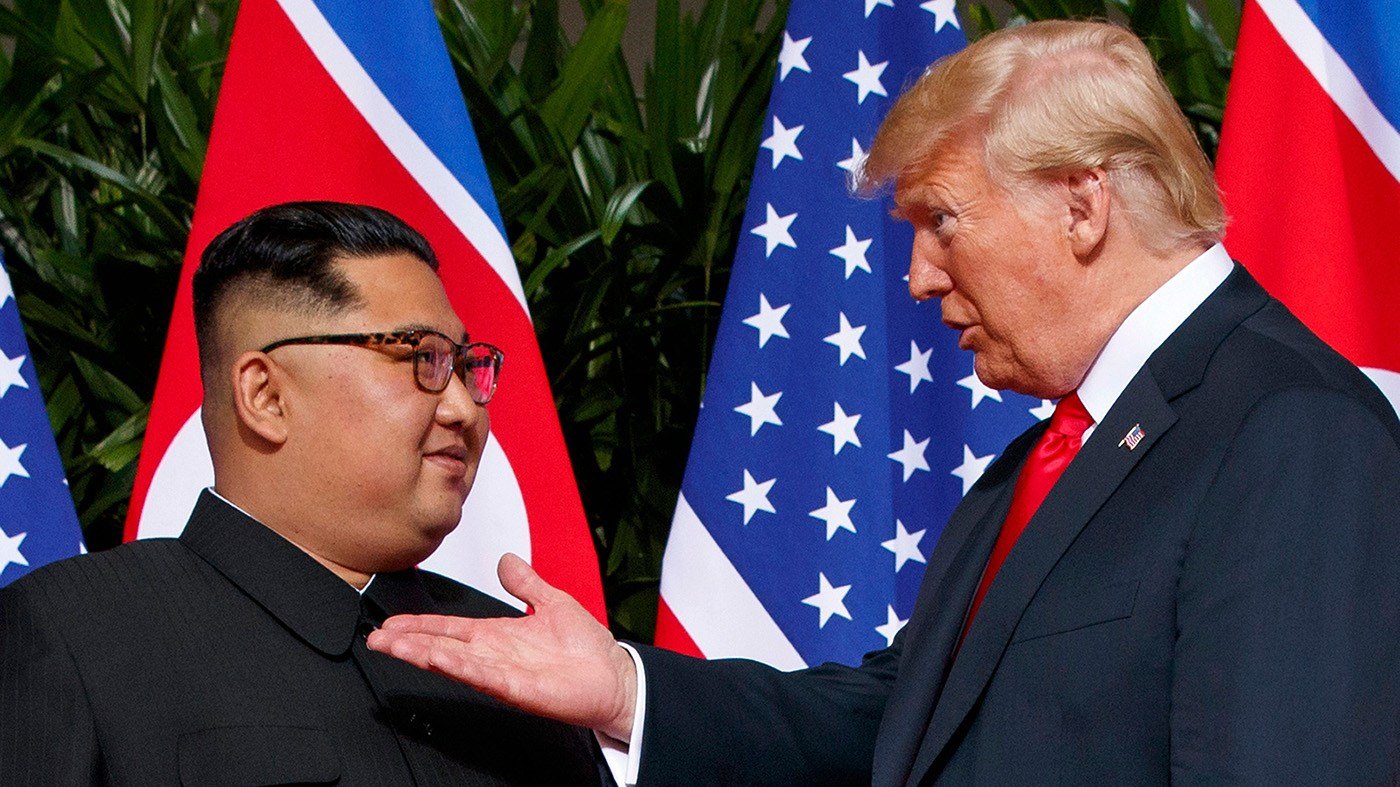
President Trump is again reaching out to North Korean leader Kim Jong Un, signaling his desire for a face-to-face meeting later this year. The move revives the personal diplomacy that defined his first term, but it also raises fresh questions about the future of the U.S.-South Korea alliance and the prospects for denuclearization.
Trump told reporters on Wednesday that he plans to meet with Kim, though he offered no details on timing or location. He framed his rapport with the North Korean leader as an asset, saying, "The fact that I get along with him — that's a good thing, not a bad thing." He also reiterated his view that North Korea's nuclear arsenal, which he described as "57 very powerful nuclear weapons," should never have been allowed to develop.
The Wall Street Journal has reported that Trump has privately discussed arranging a meeting with Kim during his upcoming trip to Asia, likely in November when he attends the Asia-Pacific Economic Cooperation summit in China. Such a summit would be the fourth between the two leaders, following three meetings in 2018 and 2019 that ultimately failed to produce a denuclearization deal.
Kim has shown little interest in engaging with Washington since Trump left office, and his sister, a top adviser, recently dismissed Trump's overtures. Experts caution that another summit could be both fruitless and damaging to U.S. credibility with South Korea.
"It's pretty clear from the first term that he views America's relationship with South Korea as a complicating factor in his ability to negotiate directly with Kim," said Michael Sobolik, a senior fellow at the Hudson Institute. "The main question I'm asking right now is: What's Kim's price going to be for face-to-face meetings with Trump?"
Sobolik noted that in Trump's first term, reducing joint military exercises with South Korea eventually led to a meeting with Kim, but that may not be enough this time. Trump on Sunday ordered the Pentagon to reduce U.S. participation in annual exercises with Seoul, calling them "provocative" and expensive. He also criticized South Korea for not supporting U.S. efforts in the Strait of Hormuz.
Seoul responded cautiously, expressing hope that improved U.S.-North Korea ties could lead to meaningful dialogue and peace on the peninsula. South Korean President Lee Jae Myung has also signaled interest in inter-Korean talks.
Andrew Yeo, SK-Korea Foundation chair at the Brookings Institution, said Chinese leader Xi Jinping could facilitate a Trump-Kim meeting if Kim sees value in it. Yeo noted that while Kim has deepened ties with Russia and China, Washington still holds things Pyongyang values, including political normalization and a reduction of the U.S. military threat.
"Even if Kim is unable to secure formal U.S. recognition of North Korea as a nuclear weapons state, simply meeting with Trump with denuclearization off the agenda, or with Trump tacitly acknowledging North Korea's nuclear weapons as a reality, would be a win for Pyongyang," Yeo said. He added that a nuclear freeze or risk-reduction agreement is more likely than complete denuclearization.
Yeo also warned that South Korea risks being sidelined. "President Lee will encourage Trump to meet with Kim in hopes that improved U.S.-North Korea relations might also pave the way for inter-Korea peace," he said. "But there's also the risk for South Korea that Trump sidelines its ally and only looks after U.S. interests in his negotiations with Kim."
The U.S. maintains about 28,500 troops in South Korea, and Washington spends more than $5 billion annually on that presence, while Seoul contributes roughly $1 billion. Trump has long pressed allies to pay more, and a senior administration official reiterated that "all our allies" must contribute more to the president's "Peace through Strength" agenda.
Sobolik said that while there may be little immediate political blowback in Seoul over the reduced exercises, "beyond this current administration in South Korea, this is going to bring up some long-standing questions about American credibility and reliability."
Kim's motivations remain unclear, but experts say he may see a summit as a way to gain legitimacy and relief from sanctions without giving up his nuclear program. The real test, Yeo said, is whether a summit leads to a sustained negotiating process with concrete, verifiable constraints.