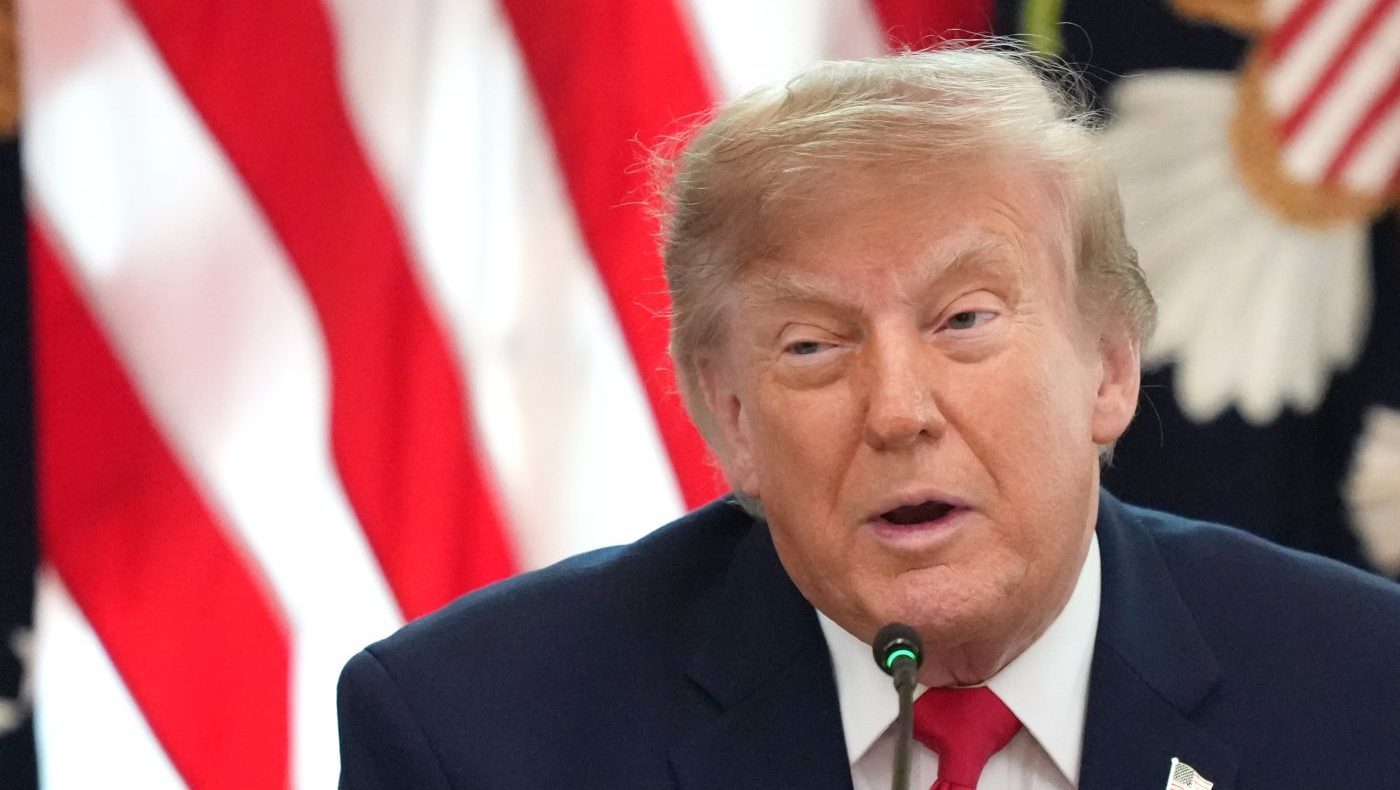
President Trump on Wednesday tied the release of an American teacher detained in Russia to his controversial decision to hold off on imposing new sanctions on Moscow, saying that moving ahead with the penalties would have scuttled the negotiations that brought Stephen Hubbard home.
Speaking at a White House roundtable on cybercrime, Trump said he was “in the midst of getting Stephen out of Russia” when critics were pressing for immediate sanctions. “If we did what these foolish people wanted me to do, he wouldn’t be coming out right now. He’d be in there for another 20 years,” Trump told reporters.
The president’s remarks came days after he signed an executive order waiving sanctions against Russia and the biggest buyers of Russian energy, a step he argued was in the U.S. national security interest. The waiver, coupled with a separate deal to purchase Russian diesel that the administration says will lower American fuel prices, drew swift backlash from both Democrats and hawkish Republicans.
Those lawmakers had championed the sanctions legislation, named after the late Sen. Lindsey Graham (R-S.C.), a close Trump ally and vocal supporter of Ukraine. The measure was designed to choke off revenue that Russia uses to fund its war effort in Ukraine.
On Truth Social, Trump wrote that “numerous people” who had urged immediate sanctions had since apologized, acknowledging they didn’t know he was negotiating Hubbard’s release. “If sanctions would have been placed, certainly those negotiations would have come to a complete and total halt,” he added.
Hubbard, 74, was arrested in 2022 after Russia’s full-scale invasion of Ukraine, where he was living in the eastern part of the country. Moscow charged and convicted him of mercenary activity, a designation the State Department has labeled as “wrongfully detained,” signaling that U.S. officials believe the charges were fabricated.
Trump’s special envoy for peace negotiations, Steve Witkoff, secured Hubbard’s release after meeting with Russian President Vladimir Putin in Moscow on Wednesday. Witkoff called Putin a “humanitarian” for agreeing to release Hubbard, a comment that drew immediate condemnation from lawmakers who pointed to Russia’s brutal bombing campaign in Ukraine and an international arrest warrant for Putin over the forced deportation of Ukrainian children.
When asked whether he agreed with Witkoff’s characterization, Trump equivocated. “Well, I guess you could say for that particular purpose, for the purpose of allowing a man who was thinking he was gonna be in prison for life out, but I wouldn’t say anything one way or another,” he said.
The episode has intensified the political debate over Trump’s approach to Russia as the midterm elections approach. Democrats have seized on the sanctions waiver as evidence that the president is prioritizing personal diplomacy over confronting Moscow, while some Republicans have defended the trade-off as a necessary cost of securing an American’s freedom. The controversy is likely to reverberate in key races, with critics accusing Trump of a sanctions flip that could weaken U.S. leverage.
Trump, for his part, has framed the waiver as a tactical move, not a concession. “We were not required to give anything in return,” he insisted, even as he acknowledged that the sanctions pause was linked to the release. The administration has also pointed to the diplomatic win as a sign of Trump’s ability to negotiate with adversaries, a message his allies are likely to amplify on the campaign trail.