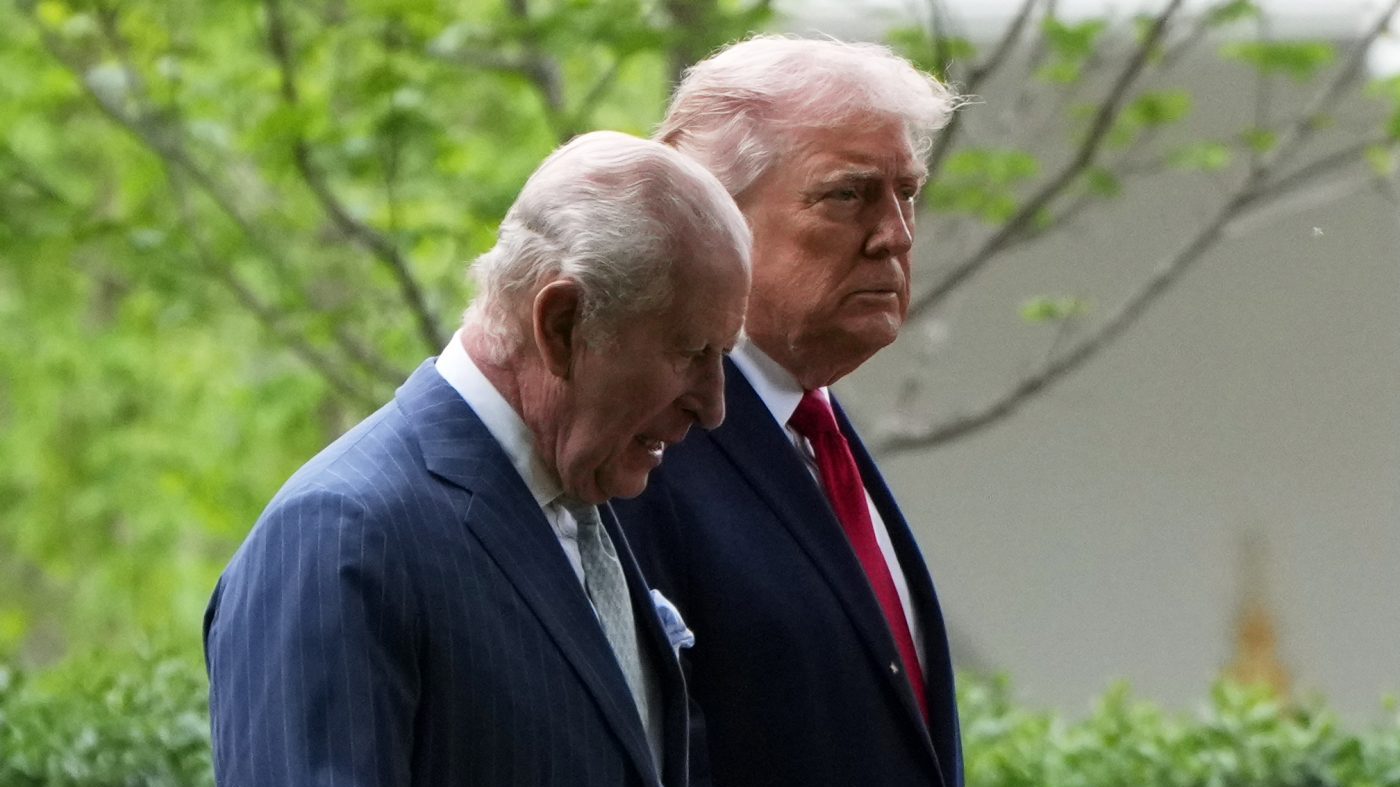
President Donald Trump on Tuesday claimed that King Charles III supports his position that Iran must never acquire a nuclear weapon, a statement that directly contradicts the British monarch’s constitutional obligation to remain politically neutral.
Speaking to reporters, Trump said, “We’re doing a little Middle East work right now, as you might know, and we’re doing very well. We have militarily defeated that particular opponent, and we’re never going to let that opponent ever—Charles agrees with me even more than I do—We’re never going to let that opponent have a nuclear weapon.” The remark came amid ongoing U.S. military operations in the region.
Under long-standing UK constitutional conventions, the monarch is expected to refrain from any partisan political commentary or involvement in government policy. King Charles’s office has not commented on Trump’s assertion, and the King’s recent address to a joint session of Congress did not mention Iran or nuclear weapons. Instead, he emphasized the importance of the U.S.-UK alliance and international cooperation.
Prime Minister Keir Starmer has publicly taken a different approach. He has repeatedly stated that the UK does not consider itself at war with Iran. “This is not our war,” Starmer said earlier this month. “We will not be drawn into the conflict.” While he has convened international meetings aimed at reopening the Strait of Hormuz and has long held that Iran should not develop nuclear weapons, his government has resisted joining U.S.-led military action.
In early March, Starmer called on Tehran to “abandon its aspiration to develop a nuclear weapon and cease its destabilising activities across the Middle East,” adding that this “has been the longstanding position of successive British governments.”
The president’s claim about King Charles comes at a time of heightened tension between Washington and London. Trump has previously floated the idea of withdrawing the U.S. from NATO after pushback from allies over his handling of the Iran conflict—a move that would require congressional approval and faces bipartisan opposition. The White House has also taunted critics with a 'Two Kings' photo of Trump and Charles, underscoring the administration's effort to project unity with the monarchy.
King Charles’s address to Congress was seen as an attempt to lower the diplomatic temperature. In it, he appealed to shared values and the need for collective action. But some observers interpreted parts of his speech as a subtle critique of Trump’s approach, particularly on global alliances.
Republicans have seized on the moment, mocking Democrats for cheering the king after their own 'no kings' rhetoric. Meanwhile, the administration continues to push its hardline Iran policy, even as allies remain wary of further escalation.