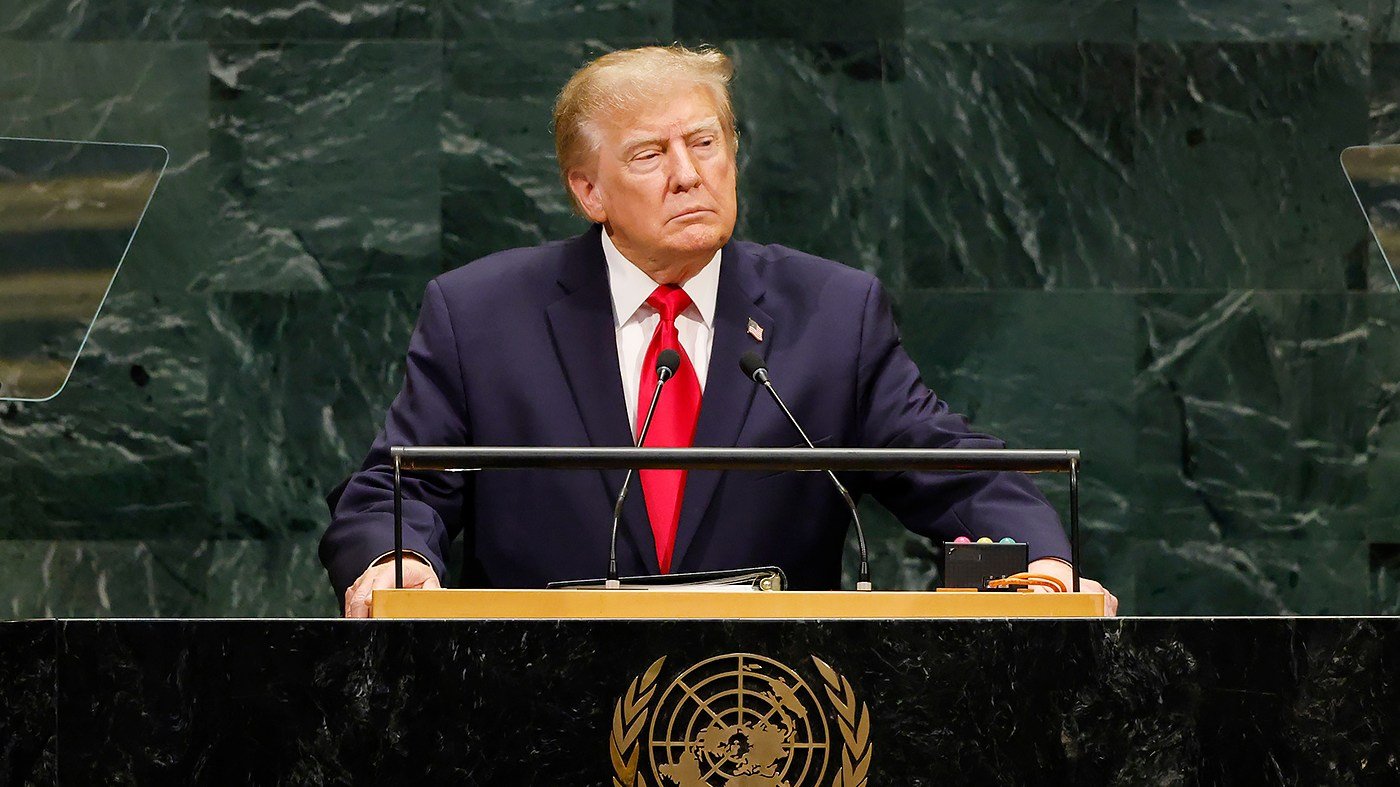
President Trump wrapped up his address to the United Nations General Assembly on Tuesday with a rhetorical flourish aimed at the future of artificial intelligence, announcing that all U.S. government documents will now refer to the technology as “super intelligence” rather than “artificial intelligence.”
“The use of the word artificial makes it sound fake,” Trump said. “It’s not fake, it’s actually amazing. But we have to be careful.” He then declared, “Welcome to the new world of super intelligence — SI.”
The president framed the rebrand as a rejection of what he called “globalist schemes” to control the technology. “The United States totally rejects any attempt to construct a globalist scheme to control,” he said, adding that the new term is “much more accurate.” He quipped, “Let’s see if that goes. It sounds much better. It is much better, and it’s much more accurate. Let’s see if I have any power. Maybe I do, and maybe I don’t. We’re going to find out pretty soon.”
The announcement was part of a broader address that touched on several high-stakes foreign policy issues. Trump also signaled a major decision on Iran, saying he faces a choice between a deal that would allow Tehran to “rebuild and create a far greater country” or “annihilate the Islamic Republic, and do it quickly.” He framed the latter as preventing Iran from “kill[ing] and destroy[ing] people and countries again.” The comments come amid ongoing tensions and a U.S. military presence in the region, and Trump suggested a resolution could come after November’s midterms.
On Ukraine, Trump said the U.S. is “working very closely” with Russian and Ukrainian leaders and predicted a swift end to the war: “We will get that one done. It’s going to happen, I think, more quickly than people understand.” He also threatened new sanctions under a law named for the late Sen. Lindsey Graham (R-S.C.) “if necessary,” which would give the president authority to punish countries trading with or supporting Russia. In a related development, CIA Director John Ratcliffe met with Ukrainian President Volodymyr Zelensky at an airport in Ireland on Monday, and special envoy Steve Witkoff and Jared Kushner recently traveled to Kyiv for talks.
Trump’s appearance at the UNGA also included a pointed attack on Cuba, prompting the Cuban delegation to walk out. He declared that “freedom will be coming to Cuba” and accused the communist regime of stirring opposition in the U.S., while vowing to continue his pressure campaign against the island nation.
Earlier Tuesday, Trump signed a security agreement with Greenland and Denmark, solidifying a larger U.S. military footprint in the Arctic. The deal, which updates a 1951 accord, will allow the U.S. to reopen a Cold War-era base and station forces at an outpost run by the Danish dogsled patrol. Trump said the agreement ensures “no U.S. adversary will ever be permitted to establish a military presence in Greenland” without U.S. approval, and Danish Prime Minister Mette Frederiksen said the pact will “show our adversaries who we are.”
Back in Washington, Sen. John Curtis (R-Utah) sent a letter to the Senate Judiciary Committee urging an investigation into the business dealings of Donald Trump Jr. and Hunter Biden, citing Trump Jr.’s recent trip to the Bahamas paid for by a Russian oligarch. Curtis argues that such foreign access raises “legitimate questions” about influence on presidential families.
Trump’s UNGA address was notable for its mix of policy pronouncements and personal asides, but the AI rebrand stood out as a signature moment. Whether the “super intelligence” label sticks remains to be seen, but Trump’s insistence on the new term reflects his broader skepticism of international governance and his preference for American-led innovation.