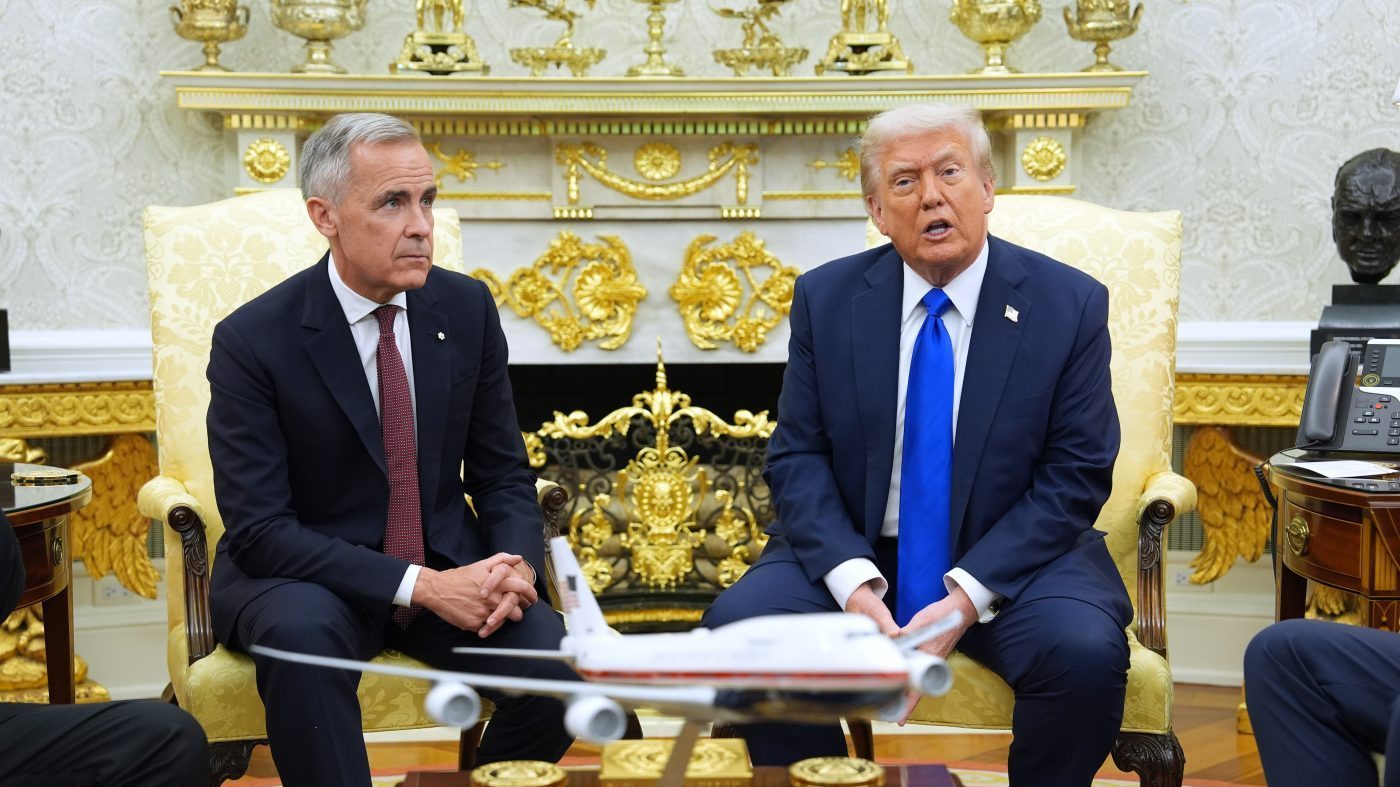
President Trump on Tuesday dismissed Canadian Prime Minister Mark Carney's claim that Washington's trade demands included rolling back French language requirements, intensifying the war of words between the two nations as trade negotiations remain deadlocked.
"I would never interfere with Canadians speaking French! In fact, I have never even thought of doing such a stupid thing," Trump wrote on Truth Social. He accused Carney of fabricating the issue to shore up political support in Quebec, adding, "This lie was made up by a weak and ineffective Prime Minister in an attempt to gain political support, which he has totally lost, from the people of Quebec. I love French Canadians!"
The president's remarks align with comments from U.S. Trade Representative Jamieson Greer, who told CNBC that Canada's claim about French language being a sticking point was a "funny, fake story."
Carney had said Monday that Canada was on the verge of a comprehensive trade agreement with the U.S. but that Washington introduced new demands, including threats to French language and cultural protections. "We were ready and close to having a comprehensive agreement that would be fair to both countries. But they made changes, including threats on the French language and Quebec culture and Canadian culture," Carney said in French during a press conference. "That is not acceptable. That would never be acceptable."
The dispute over French language requirements stems from U.S. concerns that Canada's labeling rules—which mandate French on product packaging—impose additional costs on American exporters. However, language protections are deeply embedded in Canadian law and politics, particularly in Quebec, where French is the predominant language.
The exchange comes amid a broader trade war that has seen both countries impose tariffs on a range of goods. As the conflict escalates, Canada has threatened to retaliate with its own tariffs, and Ontario's Premier Doug Ford has even floated cutting electricity exports to the U.S. Ontario's power export threat underscores the high stakes for both economies.
Trump's latest comments also come as he faces political tests at home, including a South Carolina runoff that will gauge his influence amid the ongoing trade tensions. Meanwhile, some Senate Republicans have broken with the president over his tariff strategy, particularly his push to import beef and escalate tariffs on Canada.
Analysts say the language dispute is a symptom of deeper friction in U.S.-Canada trade relations, which have deteriorated since Trump took office. The administration has repeatedly criticized Canadian trade practices, and Trump has floated symbolic gestures like renaming Lake Ontario as part of the escalating war of words.
For Carney, the French language issue is politically potent, as he seeks to maintain support in Quebec, a key battleground. But Trump's denial suggests the two leaders remain far apart, with no clear path to a negotiated settlement.