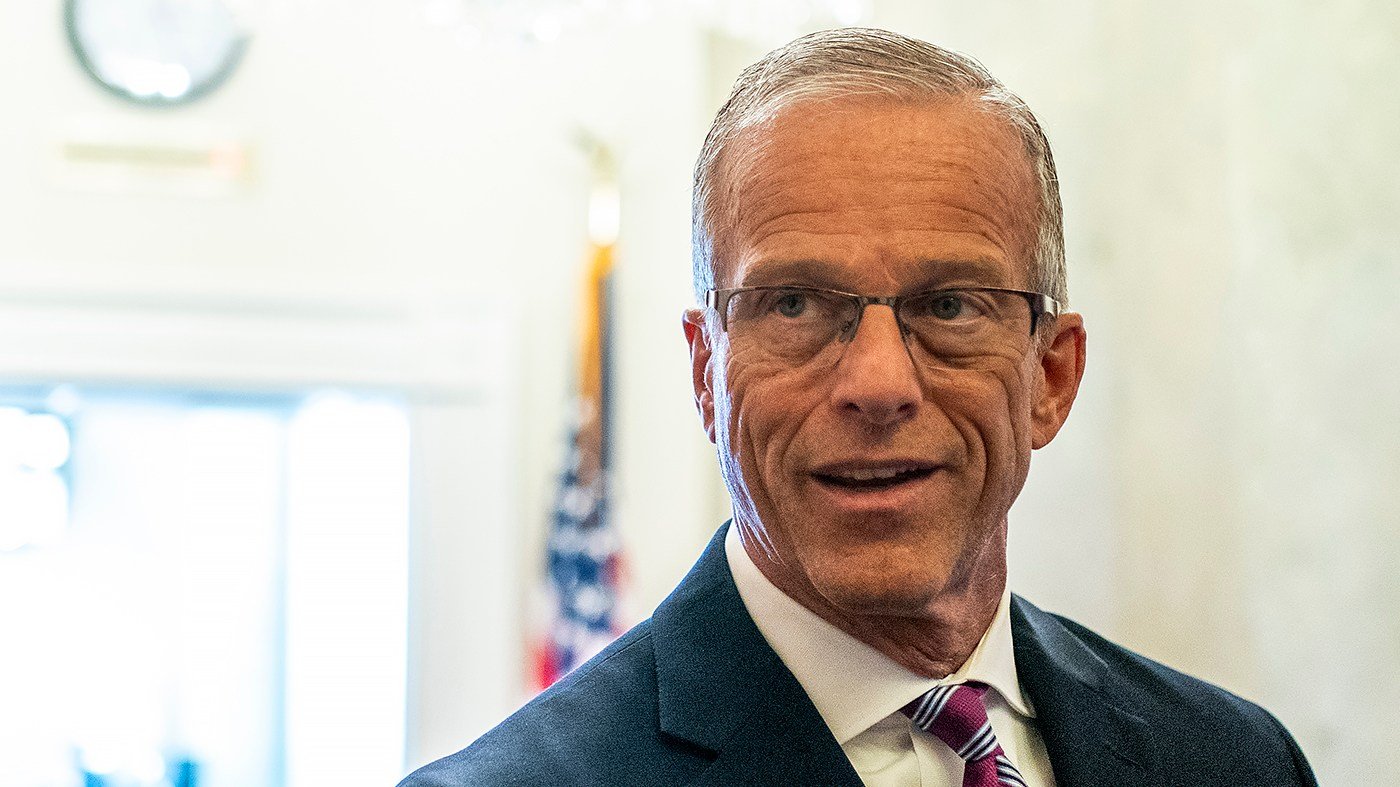
Senate Majority Leader John Thune (R-S.D.) on Monday said any congressional effort to regulate artificial intelligence should be minimal, arguing that heavy-handed rules could undercut American innovation and competitiveness. He also cast aside recent alarms about superintelligent AI posing an existential threat to humanity, calling such forecasts a “worst-case scenario.”
“It needs to strike a balance, light touch. You don’t want to stifle innovation but you also want to make sure that the more advanced threats can be mitigated,” Thune told reporters.
The remarks came after Jacob Coxon, a former researcher at OpenAI and Anthropic, publicly accused those companies of acting irresponsibly and “racing straight to self-improving superintelligence and gambling with our lives.” Thune, however, said Congress should focus on targeted safeguards for the most advanced models rather than broad regulations.
“Obviously there’s a responsibility for the companies to do that when it comes to the frontier on some of these models,” he said. “There is a way in which Congress can put guardrails around those types of more consequential threats without in any way harming our ability to stay ahead in the AI race, which I also think is very important.”
Thune downplayed the doomsday rhetoric, saying, “I think there are some potential consequential risks associated with AI. But there are always people who are creating a worst-case-scenario-type conversation out there and I think that you have to try, like all things, figure out what the realistic approach ought to be.” He added, “Put guardrails around it, like I said, I think on some of these advanced-risk-type models some guardrails there make sense to me but I think you want to do it in a light-touch way that doesn’t squash innovation.”
His comments come as Senate Democratic Leader Chuck Schumer (D-N.Y.) pressed the Trump administration for a classified briefing for all senators on AI risks. Schumer said in a statement Monday that “warning bells are ringing louder than they ever have – and the Trump administration is looking the other way. Well, if they won’t hold themselves accountable, we will. And if Trump does not act, Congress must.” He requested a full accounting of the administration’s testing framework for frontier AI models, details on efforts to block AI chips and semiconductor equipment from reaching China, and a plan to defend against AI-enabled cyberattacks.
Trump, for his part, has dismissed the need for new guardrails, writing on Truth Social that “the only control or ‘guardrails’ that AI needs is a STRONG AND SMART (High IQ!) PRESIDENT, and the U.S.A. has that, in spades!” He also claimed the administration already has “tremendous CRIMINAL and REGULATORY power over these companies” and alleged a “SICK conspiracy” against AI and data centers that benefits China.
The debate over AI regulation has intensified as lawmakers weigh the technology’s economic potential against its risks. Some Democrats, like Rep. Ruben Gallego (D-Ariz.), have likened AI to Frankenstein's monster, while others in Congress have focused on specific policy areas, such as ethics reforms and parental leave proposals.
Thune’s stance reflects a broader Republican preference for voluntary industry standards over binding regulation. He stressed that the U.S. is in a race with China, saying, “We are in a race with China and I think there’s huge upside, obviously, with AI as well. There are a lot of benefits to society along with some risks.”