A powerful El Niño is intensifying, and if current trends hold, it could become the strongest such event in over 75 years. Some forecasters even suggest it may surpass all previous records.
Dr. Jeffrey Shaman, senior vice dean and professor at the Columbia Climate School, noted that some projections indicate this could be the most intense El Niño ever recorded. However, the impacts will vary significantly by region, with some areas facing increased rainfall and others experiencing severe drought.

Rain and Drought Forecast Map
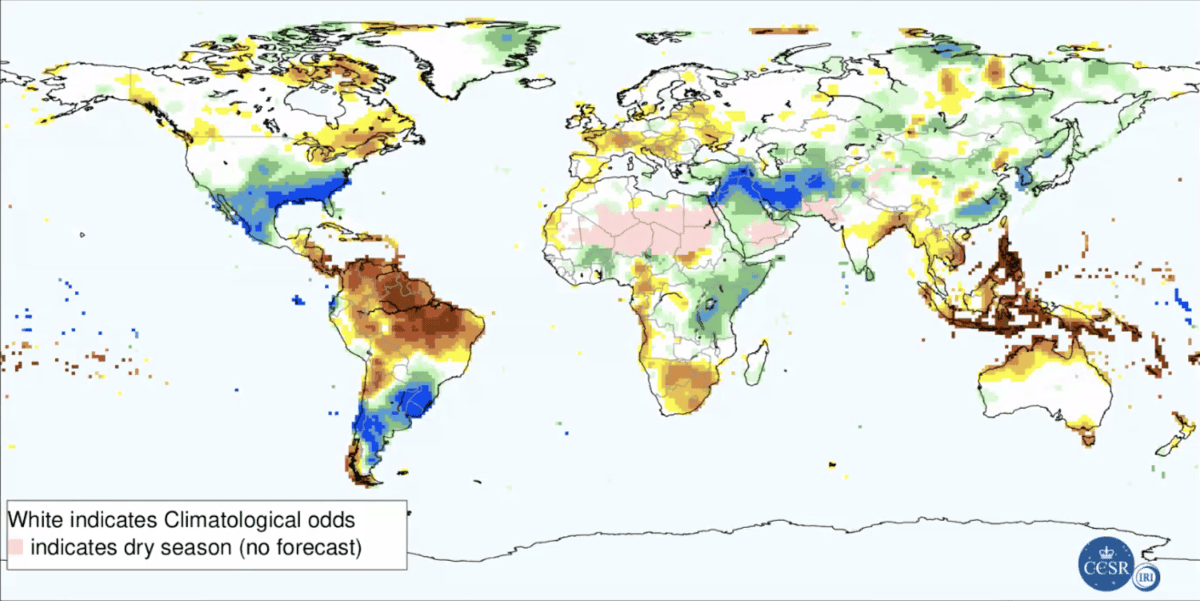
Columbia University's Center for Climate Systems Research has released a map that combines multiple climate models to predict precipitation anomalies from October through the end of the year. The map, which accounts for the current El Niño and other climate factors, highlights regions likely to see above-normal rainfall (shaded in green and blue) and those facing below-normal precipitation (shaded in yellow and brown).
In the United States, the southeastern states have the highest probability—exceeding 70%—of receiving more rain than usual. Conversely, parts of the Northeast are more likely to experience drier conditions, which could exacerbate drought or lead to new ones.
Global Impacts
Internationally, the forecast is more dire for some regions. Brazil and Southeast Asia are expected to face significant drought conditions due to the El Niño's influence. The map's predictions extend only through the end of 2026, but the super El Niño is expected to persist into early 2027.
During that later period, the West Coast of the U.S. could see notable effects: Southern California may receive more rainfall, while the Pacific Northwest could be drier than normal. The Ohio Valley also tends to experience dry conditions during El Niño years, according to typical patterns.
Uncertainty and Other Factors
Despite the strong signals, these outcomes are not guaranteed. The Climate Prediction Center emphasized that even the strongest El Niño events do not always produce the expected impacts everywhere, but stronger events can significantly tilt the odds in favor of those outcomes.
Other factors, such as rising global temperatures, also play a role in seasonal forecasts. Shaman explained that while El Niño is not the only driver, it is a major one that adds certainty to predictions.
The latest forecast from the Climate Prediction Center puts the odds of this El Niño reaching "super" status—the highest intensity level—at over 90%. There is also a 69% chance it becomes the strongest El Niño since 1950.
As the phenomenon unfolds, policymakers and communities should prepare for potential extremes, from flooding in the Southeast to drought in other parts of the world. For more on how climate patterns are affecting communities, see recent polling on extreme weather damage and divergent fall forecasts.