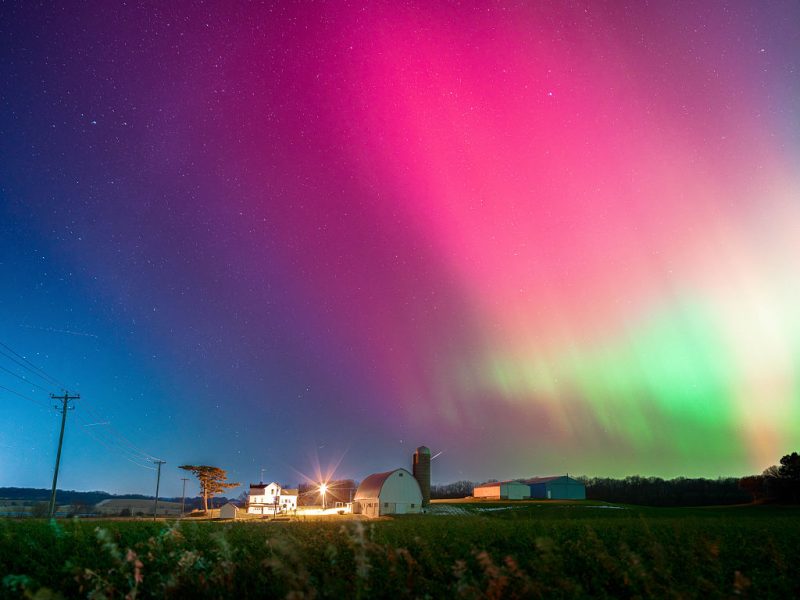
A fresh burst of solar activity is set to deliver a celestial spectacle across the northern United States, as three coronal mass ejections (CMEs) race toward Earth. The National Oceanic and Atmospheric Administration's Space Weather Prediction Center (SWPC) reports that these plasma explosions, launched since Tuesday, could trigger geomagnetic storms strong enough to make the aurora borealis visible in a wide swath of the country.
The first CME is expected to have an Earth-directed component, while the last is predicted to catch up and merge with the earlier ones before arrival. This complex series of events is further complicated by a coronal hole high-speed stream near the source region, which could deflect energy northward and above Earth's orbit, according to the SWPC.

Forecasters caution that the timing and intensity remain uncertain. As of Thursday morning, the SWPC's best estimate points to geomagnetic storming reaching G3 strength—the third level on a five-point scale—with a possibility of G4 if the CMEs hit harder than models suggest. The storms could arrive as early as mid-afternoon Thursday, which would affect viewing opportunities after sunset.
For aurora enthusiasts, the key factor is whether the storms persist into the night. If conditions hold, the northern lights could be visible in states including Washington, Oregon, Idaho, Montana, Wyoming, North Dakota, South Dakota, Nebraska, Minnesota, Iowa, Missouri, Wisconsin, Illinois, Michigan, Indiana, Ohio, Pennsylvania, West Virginia, New Jersey, New York, Connecticut, Rhode Island, Massachusetts, Vermont, New Hampshire, and Maine. Residents in parts of California, Nevada, Utah, Colorado, Kansas, Oklahoma, Arkansas, Mississippi, Alabama, Georgia, South Carolina, North Carolina, Tennessee, Kentucky, and Virginia might catch a faint glow along the northern horizon.
This event follows a historic solar radiation storm earlier this year that brought the aurora to much of the U.S. While the current storm is expected to be weaker, it still offers a significant viewing opportunity. The aurora is caused by CMEs—explosions of plasma and magnetic material that interact with Earth's magnetic field, sending particles to the poles where they collide with atmospheric gases to produce vibrant colors.
Experts recommend looking toward the northern horizon for the best chance of seeing the display. For those struggling to spot the lights with the naked eye, using a smartphone camera can help, as modern digital lenses are more sensitive to low light and can capture the green, pink, and red hues.
The SWPC's forecast is based on data from NOAA, but space weather predictions remain inherently uncertain due to the sun's distance of 93 million miles. The agency will continue to monitor the CMEs as they approach, updating forecasts in real time.
This celestial event comes amid a busy political season, with primaries in six states and a heated debate in New York's 12th Congressional District drawing attention to the open seat race to replace Nadler. Meanwhile, a Supreme Court ruling on Alabama's congressional map has sparked controversy over minority representation.