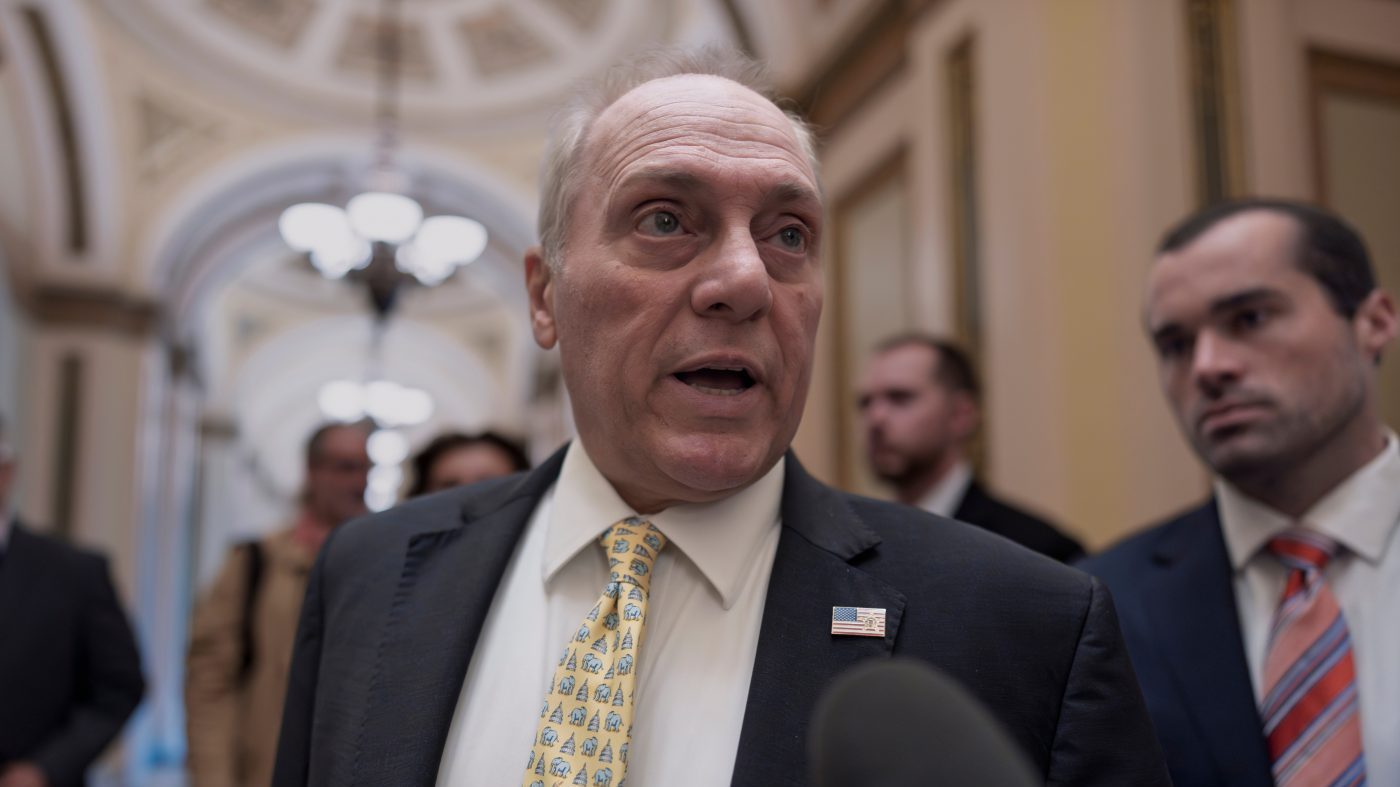
House Majority Leader Steve Scalise (R-La.) found himself on the defensive Thursday during a contentious exchange on CNBC's Squawk Box, as host Joe Kernen pressed him on surging fuel prices tied to the ongoing conflict in Iran.
The national average for a gallon of regular gas hit $4.30 on Thursday, according to AAA, marking the highest level in four years. The spike comes as the war in Iran stretches past 60 days, with the effective closure of the Strait of Hormuz—a critical oil trading corridor—disrupting global supplies.
Scalise sought to minimize the jump, telling Kernen that prices remain far below the peaks seen under the Biden administration. “We’ve delivered,” Scalise said, touting Republican economic policies. “People will remember that two years ago, we were paying almost $6 a gallon for gas. Right now it’s $3.”
Kernen immediately challenged that comparison, noting that the figures Scalise cited don’t reflect the 2024 median. According to data, the average price for regular gas in 2024 was $3.30 per gallon, with a peak of $3.67 in April of that year. “You must have been on vacation in California,” Kernen shot back. “I think two years ago in April of 2024, we were at about $3.65, so we’re actually above where we were then.”
Scalise insisted that under Biden, prices were “well into the fives,” referencing the all-time national average of $5.02 per gallon in June 2022, driven by Russia’s invasion of Ukraine. But Kernen’s rebuttal highlighted a key political vulnerability for Republicans: voters are now paying more at the pump than they did in much of 2024, even if below the 2022 peak.
The current price surge is directly linked to the Iran conflict. President Trump has imposed a naval blockade on Iranian ports and certain ships transiting the Strait of Hormuz, effectively shutting down a major oil route. On Wednesday, Trump rejected a fresh Iranian request to lift the blockade, citing Tehran’s lack of concessions on its nuclear program.
Beyond gasoline, the conflict has pushed up inflation and constrained global supplies of goods like fertilizer and helium. The Trump administration has dismissed these pressures as “short term” costs of securing a new nuclear deal with Iran, but the economic strain is already creating political headaches for Republicans heading into the November midterms.
“Affordability is going to be a central issue at the ballot box,” said one GOP strategist, speaking on condition of anonymity. “If gas stays above $4, it doesn’t matter what the White House says about long-term gains—voters will feel it in their wallets.”
For now, the clash between Scalise and Kernen underscores the delicate balancing act for Republicans: defending the administration’s Iran policy while managing voter frustration over rising costs. With the Strait of Hormuz still closed and no breakthrough in nuclear talks, the pressure is only likely to intensify.