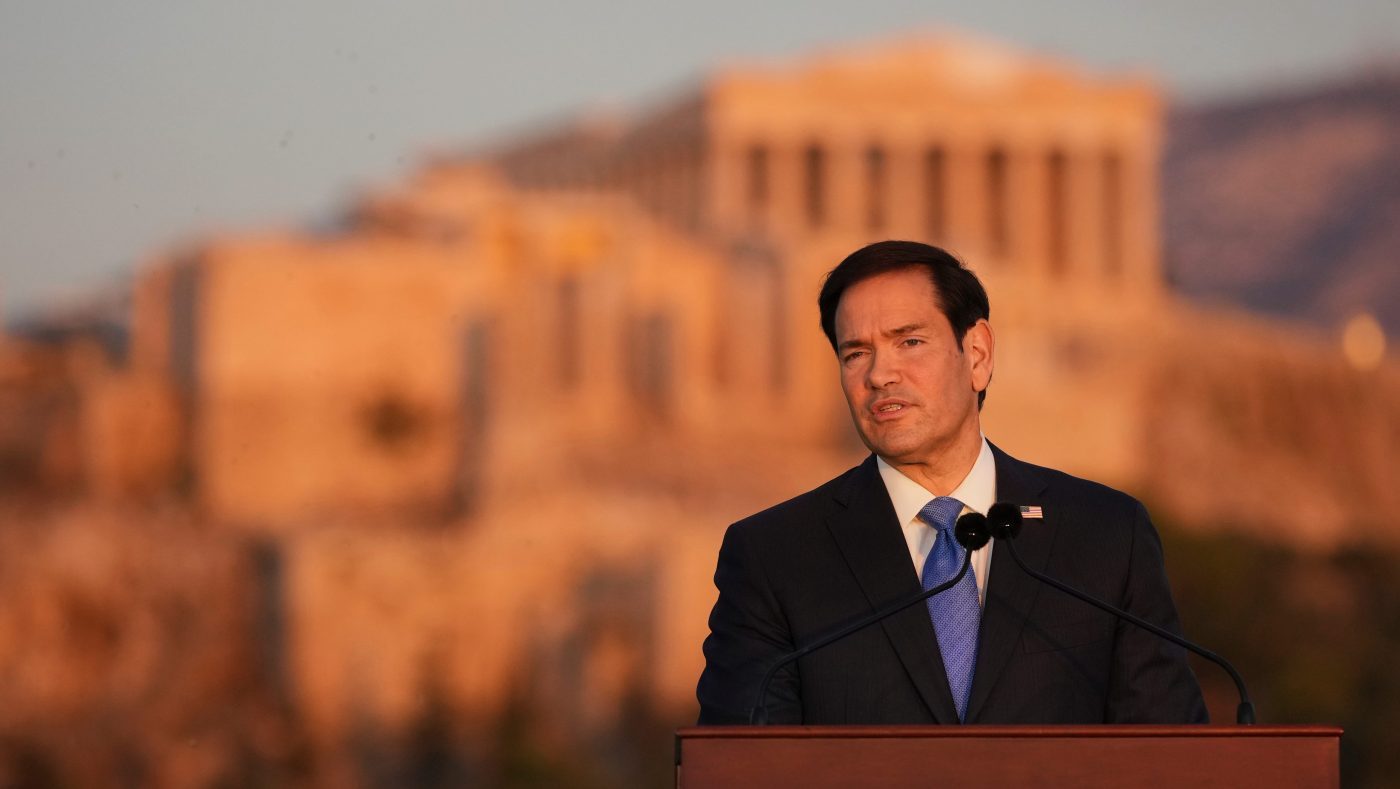
Secretary of State Marco Rubio delivered a sweeping address in Athens on Wednesday, calling for a renewed partnership between the United States and Europe to confront global challenges. Speaking against the backdrop of the Acropolis and the setting sun, Rubio framed the moment as a crossroads for the West, warning that it must either maintain its leadership or resign itself to a future of decline.
Rubio's remarks were steeped in classical references, invoking ancient Greek traditions of contest and ambition. He argued that too much of the West has forgotten these qualities, criticizing historical reexaminations and what he called a collective failure to maintain military strength. He urged allies to awaken from a 'long slumber' and rekindle the fire of Western civilization.
The speech comes at a time when transatlantic relations are strained by President Trump's trade policies, threats to NATO allies, and a controversial military campaign against Iran. Rubio acknowledged these tensions but sought to project unity, saying, 'We want to win together. We must win together.'
Rubio's address is widely seen as part of his broader political positioning. Although he has said he has no plans to run for president in 2028, his performance in hypothetical matchups and a straw poll suggests he is a leading contender for the Republican nomination. His speech, with its cinematic production and grand setting, is likely to fuel further speculation.
The secretary also touched on specific policy areas, including the recent trilateral security agreement involving the U.S., Denmark, and Greenland, which seemed to resolve Trump's push to take over the Arctic island. Rubio emphasized the importance of alliances in defending national sovereignty, rather than undermining it.
Rubio's message was aimed at reassuring European allies, who have been unsettled by the administration's aggressive rhetoric. Unlike Vice President Vance's controversial address at the Munich Security Conference last year, Rubio received praise for his remarks this year, positioning him as a more palatable messenger for the administration.
As Rubio continues to navigate his role as both secretary of state and national security adviser, his Athens speech underscores the administration's focus on projecting strength and unity abroad. Whether it will resonate with European leaders remains to be seen, but the imagery and rhetoric were unmistakably aimed at a global audience.