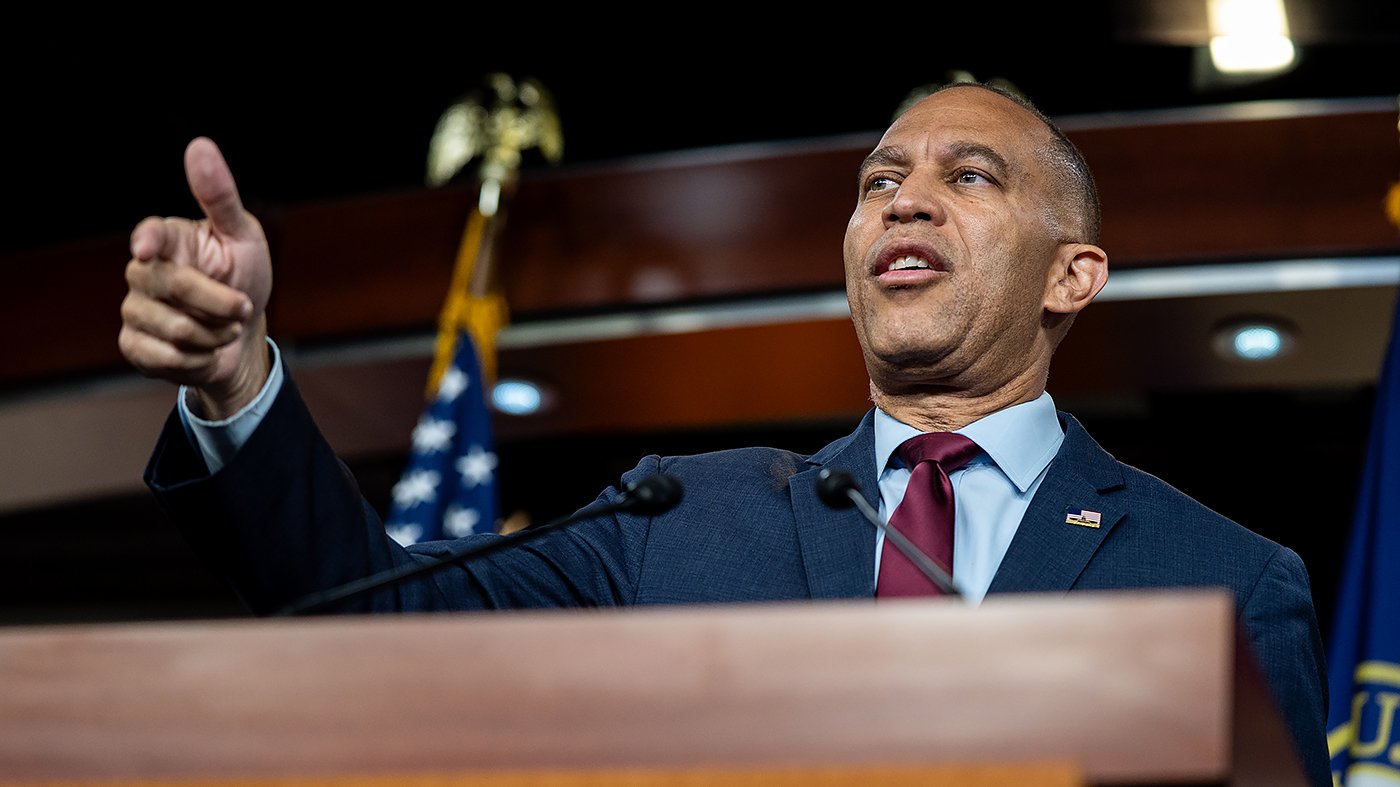
A recent surge of progressive primary victories is giving the left wing of the Democratic Party renewed confidence and could pose a significant challenge for House Minority Leader Hakeem Jeffries (D-N.Y.) if Democrats reclaim the chamber in 2026.
The wins come amid growing demand from Democratic voters for a more aggressive policy direction. That mood was evident last week in Michigan, where Bernie Sanders-backed progressive Donavan McKinney ousted Rep. Shri Thanedar in a Democratic primary. In a separate Michigan contest, progressive Abdul El-Sayed defeated moderate Rep. Haley Stevens, a result that sent shockwaves through the party establishment.
Last month, 29-year-old democratic socialist Melat Kiros unseated 15-term Rep. Diana DeGette in Colorado, while New York Reps. Adriano Espaillat and Dan Goldman also lost their primaries to progressive challengers. These outcomes have amplified the voice of the Congressional Progressive Caucus and raised the stakes for leadership.
Should Democrats win the House, Jeffries would face the delicate task of bridging the gap between progressives who view their victories as a mandate for sweeping reforms and moderates in swing districts who fear that ambitious votes could hand Republicans political ammunition. With a potentially narrow majority, even a handful of defections could sink the party's legislative agenda.
"Any division within our caucus on galvanizing issues, we lose the war and the battle," said Democratic strategist Antjuan Seawright. "If we're in a split government situation—House but not Senate, or vice versa—it makes it even more important to present a unified front at almost all times."
The fault lines are most visible on issues like the Israel-Palestine conflict. Progressives have increasingly labeled Israel's military campaign in Gaza as genocide and pushed to condition or halt U.S. aid, while many moderates maintain strong support for Israel. Rep. Jared Huffman (D-Calif.), a Progressive Caucus vice chair, acknowledged the tension but noted a shift even among moderate Democrats.
"The ground is shifting," Huffman said. "It's because of what Israel's been doing the last couple of years—the aggression, the atrocities, the lawlessness. It's become impossible to look away."
Immigration enforcement is another flashpoint. Progressives advocate for more protections for undocumented immigrants, while moderates emphasize border security. Huffman stressed that the party is not monolithic, unlike Republicans, and that "there needs to be space for diversity and debate."
Strategist Fredrick Hicks predicted the real friction will emerge over social issues, including transgender rights and diversity, equity, and inclusion policies. "The challenge for leadership is not just picking which policies to address but which ones to prioritize," Hicks said. "That's where existing fissures will emerge."
Rep. Alexandria Ocasio-Cortez (D-N.Y.) defended the new wave of candidates, telling ABC News that many "insurgent candidates" are independent and "not beholden to any corporate interest or any party boss."
Despite the divisions, there is common ground on affordability. Jeffries has emphasized a focus on "fighting for an affordable America," noting that "everybody agrees" the cost of living is a defining issue. He is widely expected to remain leader regardless of the midterm outcome, but some progressive primary winners, like Darializa Avila Chevalier and Claire Valdez in New York, have not committed to backing him.
The coming months will test whether Jeffries can forge unity amid a progressive surge that shows no signs of slowing.