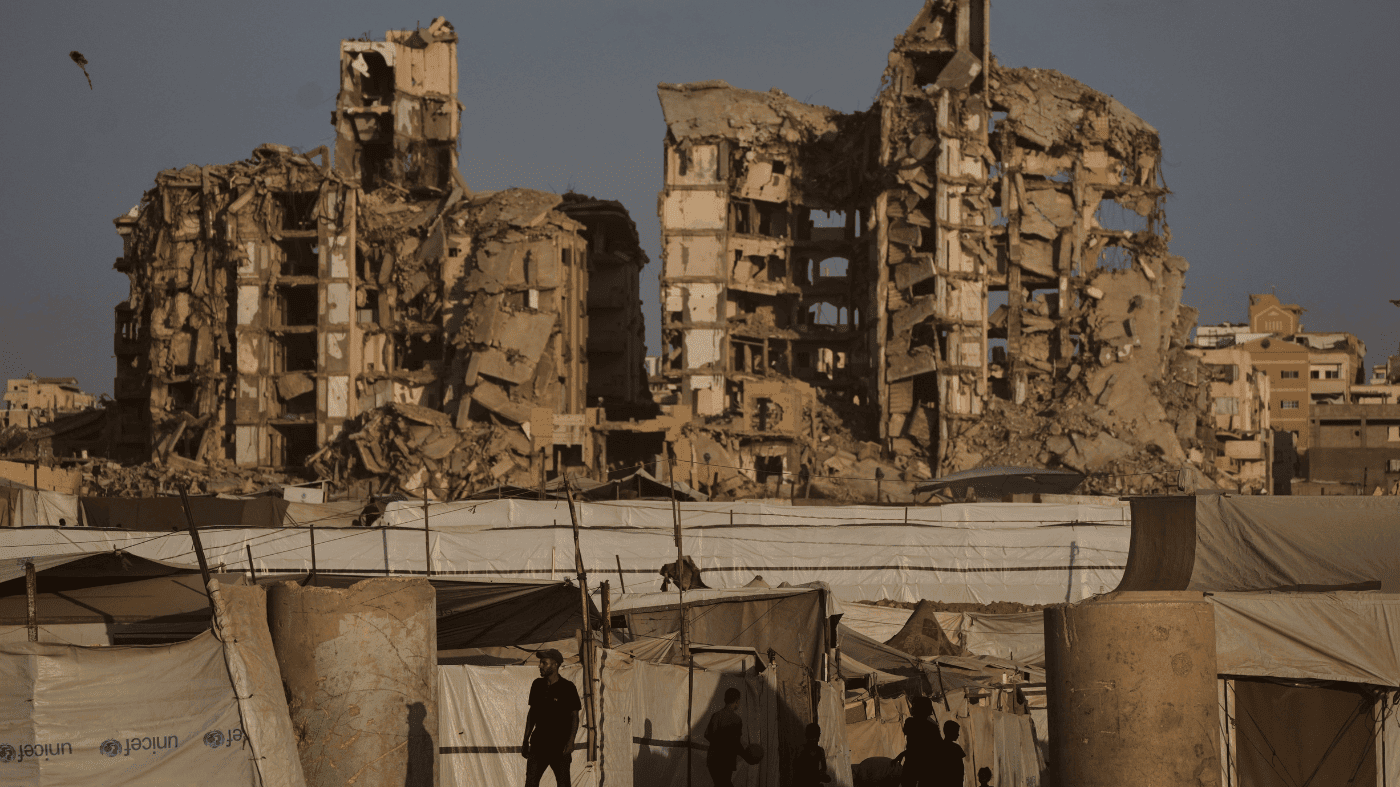
Israelis are still debating whether the United Arab Emirates warned Israel of an imminent Hamas attack roughly 10 days before the Oct. 7 massacre. But fixating on the days before the attack obscures a deeper flaw: Israel's strategic conception remains largely unchanged. It is conflict management.
Israel is a weakened and deterred Hamas ruling Gaza as an excuse to deepen the divide between Gaza and a Palestinian Authority-run West Bank. By avoiding allowing any alternative to emerge, it is sidelining the Palestinian question altogether.
If the deadliest disaster of Jews since the Holocaust should have changed one thing, it was this. Yet, strip away the rhetoric of "total victory," and Israel's Gaza policy today looks quite similar, just with more bloodshed and rubble.
In recent weeks, Israeli leaders have vowed to remain in Gaza for the long term and end Hamas's rule once and for all. Following a string of successful assassinations of Hamas commanders, Prime Minister Benjamin Netanyahu and Defense Minister Israel Katz declared: "Our message is clear: No terrorist is immune, and Hamas will not be in Gaza."
Weakening Hamas is legitimate, and so is Israel's demand that it relinquish control of Gaza. But Israel's revealed preference tells a different story.
Even as Israel holds an estimated 60 percent of Gaza, Hamas still controls over 95 percent of the population. Hamas is both a terrorist organization and Gaza's de facto government; removing the former requires an alternative for the latter. Israel refused to hand that role to the Palestinian Authority but signed on to President Trump's 20-point plan last year, which offers exactly that: a transition to the technocratic National Committee for the Administration of Gaza, eventually leading to a reformed Palestinian Authority.
The Israeli government apparently never intended to let that alternative emerge.
Members of the National Committee for the Administration of Gaza remain in Cairo, with no timeline for entering Gaza. Roughly 6,000 vetted police recruits, meant to begin training months ago, have not left Gaza because Israel will not commit to letting them return.
Construction of a base for the International Stabilization Force is stalled by bureaucracy. Reconstruction of the Israeli-held "Green Zone" meant to showcase non-Hamas governance hasn't advanced. And in the West Bank, Israeli policy is weakening the Palestinian Authority toward collapse and carving the territory into cantons to ensure no Palestinian governance, with or without Gaza, is ever viable.
Hamas has expectedly stalled the plan too. But in August it accepted the Board of Peace's roadmap, listing 15 principles for phased disarmament in exchange for Israel Defense Forces withdrawal. Israel has valid concerns, including the roadmap's timeline, scope of disarmament and Qatar and Turkey's role in verifying compliance.
But justified skepticism does not excuse refusing to engage. Instead of making Hamas back its words, Israel has effectively handed it veto power over the process, drawing international blame for stalling while Hamas gains recognition as a legitimate partner.
Domestic politics explains much of this. Israel faces a charged election on Oct. 27, and Netanyahu's coalition cannot show compromise on Gaza. Even pressure from Trump plays in his favor, as he claims to be the only one who can stand up to who he called "the greatest friend that the state of Israel has ever had in the White House." Netanyahu's rivals, meantime, are trying to outflank him from the right, vowing to keep fighting rather than engage the U.S.-led plan.
But whoever wins will still have to pick up the Trump framework. The alternatives — renewed full-scale war or a Gaza permanently split between an Israeli-held east and Hamas-run west — serve neither Israel's security interests nor produce an acceptable status quo.
Rather than campaigning on the same hawkish instinct, prime minister contenders should say that the current approach only keeps Hamas in power: deterred, but not replaced, with no real alternative given a chance.
A future Israeli government that wants a different outcome will have to act like it. This means setting a political horizon instead of managing the conflict incident by incident, taking initiative on the Trump plan and disarmament roadmap instead of being dragged along by Washington, Cairo, or Doha.
It also requires letting the National Committee for the Administration of Gaza function and supporting Palestinian Authority reform rather than treating its flaws as a pretext for exclusion and redirecting Gaza's financial lifelines to starve Hamas economically rather than merely bombing it.
Such a shift could unlock the funding, troops and regional cooperation the plan needs, and begin restoring Israel's ties with Europe and the Arab world.
A new government will find it hard to change course quickly. The only way to make that happen is U.S. leadership from the top, because whoever wins will want Trump on their side.
The ceasefire, the hostages' return and the 20-point framework a year ago were a major achievement. The Trump administration can use this anniversary and Israel's election to press ahead. Otherwise, Israel risks drifting back into an Oct. 6 reality: a contained, managed Hamas quietly rebuilding behind a calm facade, primed to explode again.
Shira Efron is the Israel policy chair and a senior fellow at RAND.