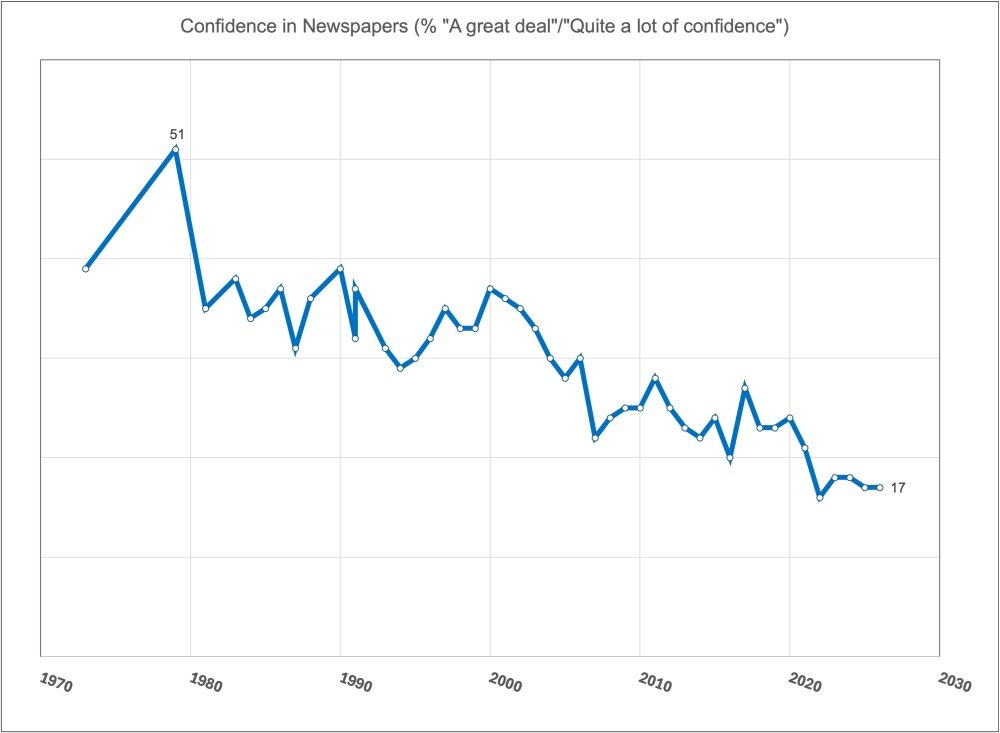
Remember the hopeful chatter after the 2016 election, when many journalists predicted a renaissance for their profession? That optimism feels ancient now. The reality, as laid out in fresh Gallup data, is stark: the news media now ranks among America’s least-trusted institutions.
Only 17% of Americans express “a great deal” or “quite a lot” of confidence in newspaper reporting—a single-point drop from last year. Television news fares even worse, at a dismal 14%. That figure, though up three points from 2024, remains nothing to celebrate. For context, the presidency, the Supreme Court, and even big banks each enjoy roughly double the public’s trust. Only Congress, languishing at 9%, sits lower.
The two least-trusted entities in the country are now Congress and television news, separated by a hair’s breadth. Even the medical system and banks command far more confidence than either print or broadcast journalism. This isn’t a temporary dip; it’s a record low, and recovery seems distant.
The collapse cuts across party lines. Among Democrats—the group most favorable to the press—only 16% trust TV news and 22% trust newspapers. Republicans and independents are even more skeptical. Notably, the only institutions where Democratic confidence outpaces that of both other groups are higher education, public schools, organized labor, and newspapers.
Can audiences be blamed? Viewer bias certainly plays a role, but it can’t explain the wholesale erosion of credibility. A fair assessment forces a harder conclusion: the media did this to itself. Decades of sloppy, one-sided reporting and a near-total disregard for audience feedback have brought us here. If anything, the failings have worsened.
Recent coverage offers damning evidence. CNN, in reporting on Republicans claiming contact with Sen. Mitch McConnell, cited a tweet from “Rep. Jack Kimble” of California’s 54th district—a district that doesn’t exist. “Jack Kimble” is a satirical Twitter account; Poe’s Law is an internet adage, not legislation. CNN didn’t bother to verify.
Then there’s the NPR debacle, where Supreme Court reporter Nina Totenberg falsely declared Justice Samuel Alito had retired. She had a pre-written story ready; Alito had said nothing. NPR blamed the error on trusting Totenberg’s judgment; she claimed she misheard Chief Justice John Roberts.
MSNBC viewers were told that President Trump is largely to blame for the Supreme Court’s security concerns—not the Democratic lawmakers, left-wing activists, or would-be assassins who have threatened justices. Contributor Mark Stern cited Trump’s post-tariffs-decision comments, ignoring that the assassination attempt on Justice Brett Kavanaugh followed the Dobbs leak. Justice Amy Coney Barrett recently testified that threats “were particularly intense a few years ago around the Dobbs leak,” requiring her to wear a bulletproof vest. Her family was swatted in May.
NBC News didn’t cover Barrett’s or Justice Elena Kagan’s congressional testimony on its flagship evening program. Instead, NBC Nightly News led with a story about a medical condition involving diarrhea. The allegory writes itself.
The media’s crisis isn’t just about trust—it’s about accountability. As readers and viewers, we’re left wondering: if the press can’t get basic facts right, why should anyone believe the rest? The path back to credibility starts with rigorous fact-checking and a willingness to listen, not just lecture.