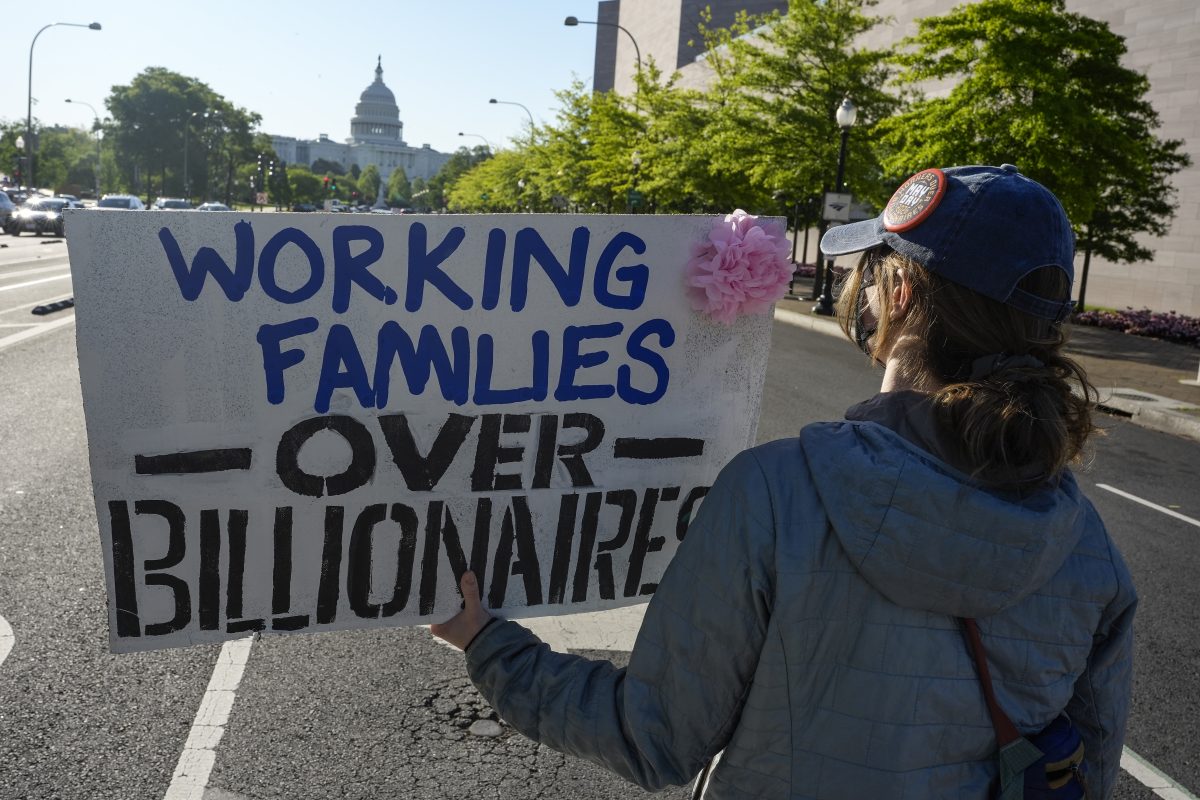
Thousands of demonstrators took to the streets across the United States on Friday as part of the “May Day Strong” protests, a coordinated wave of rallies targeting what activists describe as a political system rigged to benefit billionaires at the expense of ordinary workers. The protests, organized by a coalition of labor unions and activist groups, unfolded at thousands of locations nationwide, with demands ranging from taxing the wealthy to opposing immigration enforcement and military interventions.
The coalition, which includes the National Education Association (NEA) and the Communication Workers of America (CWA), as well as the 50501 network that previously organized anti-Trump protests under the “No Kings” banner, framed the day as a broad rebuke to policies enacted by the Trump administration. “On May 1, 2026, workers, students, and families rally, march, and take action across the country to demand a nation that puts workers over billionaires,” the group stated on its website.
Key Demands and Local Actions
The coalition’s central demands include “tax the rich,” “expand democracy,” “no ICE,” and “no war.” Some demonstrations zeroed in on specific targets. In Blackshear, Georgia, protesters rallied against U.S. involvement in Venezuela, while in New York City, a protest dubbed “Amazon Delivers ICE” called out the tech giant for its contracts with the Department of Homeland Security. Signs carried by demonstrators read, “Amazon tech helped deport my neighbors,” underscoring the intersection of corporate power and immigration enforcement.
In addition to physical rallies, the May Day Strong coalition urged supporters to participate in a “general strike” of sorts, calling for “no work, no school, no shopping” on May 1. “The basics of a good life — an affordable home, quality healthcare, nutritious food, a dignified job, and beyond — are increasingly out of reach for millions of Americans,” the group wrote in an online toolkit. “At the same time, big corporations and the super-rich are posting record profits, protected by rules that work for them while shifting higher costs onto everyone else.”
Criticism and Counterarguments
The protests have drawn sharp criticism from conservative groups. Scarlett Johnson, a Moms for Liberty activist, accused organizers of targeting schools and children. “These May Day organizers have put schools, and schoolchildren directly in their crosshairs,” she said. Other critics have labeled the movement as aligned with communist ideals, though organizers reject that framing, emphasizing their focus on economic justice and democratic reform.
The timing of the protests comes amid broader political battles, including ongoing debates over redistricting and federal appointments. A recent Supreme Court ruling has ignited new redistricting fights in Southern states, a development that could further energize progressive activists. Meanwhile, the Trump administration’s push to replace independent experts with loyalists continues to reshape federal agencies, a trend that May Day Strong organizers argue undermines democratic accountability.
Historical Roots and Global Context
May Day has deep roots in U.S. labor history, tracing back to the 1880s when unions fought for an eight-hour workday. The 1886 Haymarket affair in Chicago, where a bomb explosion and police gunfire led to the execution of several labor activists, remains a touchstone. A monument in Chicago’s Haymarket Square commemorates them: “Dedicated to all workers of the world.” In 2006, the focus shifted to immigration, with roughly 1 million people protesting federal legislation that would have made unauthorized residency a felony.
Globally, May Day is a public holiday in many countries, and this year saw protests from Manila to Paris. In Indonesia, President Prabowo Subianto joined a rally in Jakarta, where workers demanded stronger government protection amid rising prices. In Istanbul, police detained 15 protesters attempting to reach Taksim Square, a symbol of past dissent. In France, unions pushed back against a parliamentary proposal to expand work on May Day, with politician Serge Papin noting, “May 1 is not just any day. It symbolizes social gains stemming from a century of building social rules.”
As the May Day Strong protests unfolded, they served as a reminder of the enduring tensions between labor and capital, and the growing frustration among many Americans with a political system they see as tilted toward the wealthy. Whether these demonstrations translate into broader political change remains to be seen, but the coalition’s ability to mobilize thousands of activists across the country signals a sustained energy on the left.