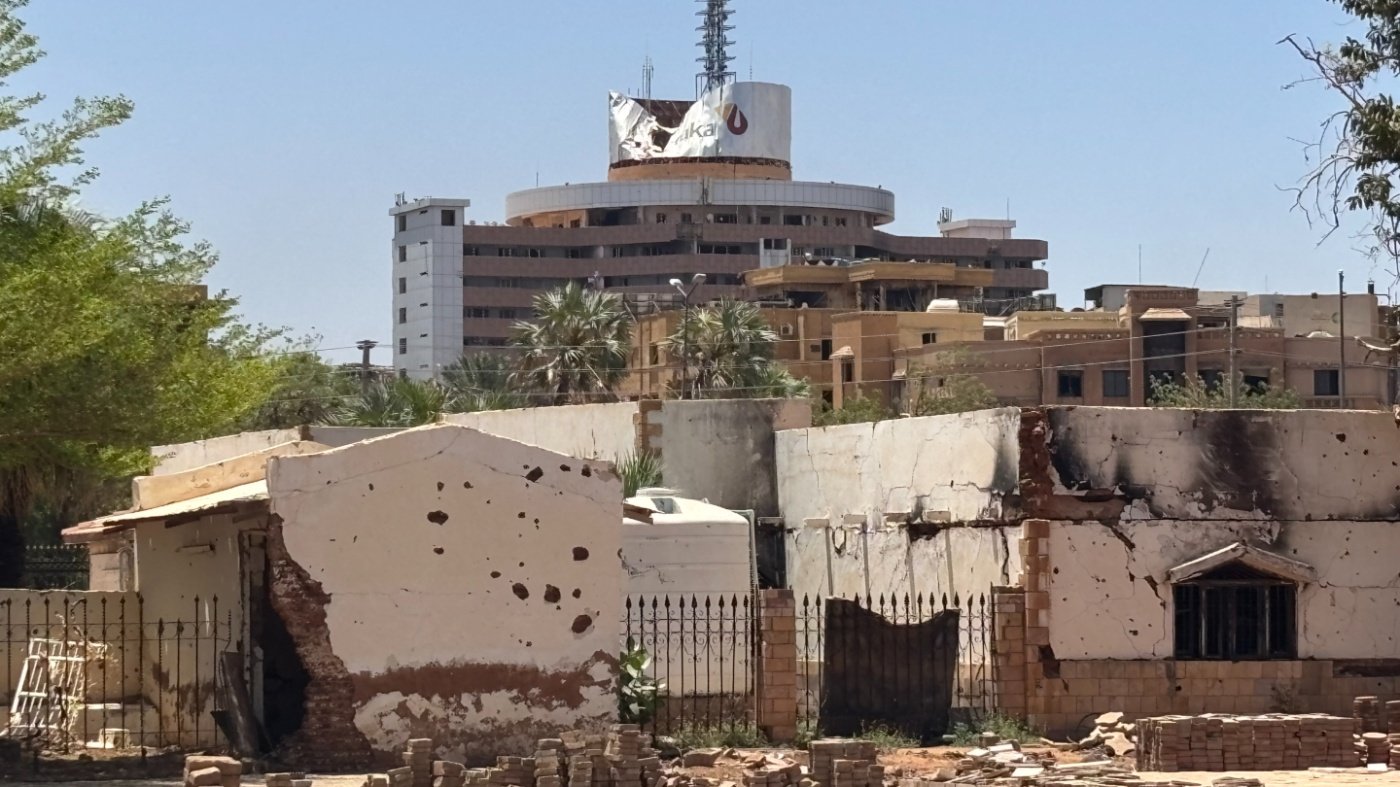
KHARTOUM — A year after Sudanese forces reclaimed the capital from paramilitary rivals, vast stretches of the city resemble a war museum. The presidential palace stands gutted, its arches blackened by fire, windows blown out, columns crumbling. Posters of teenage soldiers killed in battle are plastered on walls pocked with bullet holes. Burned-out vehicles line the streets, and bombed aircraft still sit on the tarmac of Khartoum International Airport, which only resumed domestic flights in February.
For a journalist granted rare access, a few days in Khartoum make clear the scale of the rebuilding challenge facing Sudan's military-led government — and the grim reality of a conflict now entering its fourth year with no ceasefire in sight.
A Delegation Under Watch
This correspondent joined five other foreign journalists on a weeklong trip organized by the ONE Campaign, the advocacy group co-founded by Bono. The Sudanese Armed Forces (SAF)-dominated government closely managed the visit, arranging transport, suggesting interview subjects, and monitoring some independent meetings. Still, conversations in Khartoum and Port Sudan revealed that ordinary citizens and activists continue to push for peace and a new political order.
“Either there's Sudan or not,” said Sulaima Elkhalifa Sharif, director of the government's Combating Violence Against Women Unit. She survived an RSF crackdown on protesters in 2019 that killed over 100 people and was detained by the army in 2022 for exposing military-perpetrated sexual violence. Yet she now works within the SAF-controlled administration. “It doesn't have to be elected, but it's a transitional government. Sudan needs time to breathe.”
War by Proxy
The conflict, which erupted in April 2023 between SAF chief Gen. Abdel-Fattah Burhan and RSF leader Mohammed Hamdan “Hemedti” Dagalo, has become the world's worst humanitarian crisis. Foreign powers fuel both sides: the United Arab Emirates backs the RSF, while Saudi Arabia and Egypt support Burhan. The Trump administration has largely ignored the war, focusing on Ukraine, Gaza, and Iran. A bipartisan group of senators has called for labeling the RSF a terrorist organization, and Democrats recently introduced legislation to hold the UAE accountable.
“This is intentional. It's not forgotten; everybody knows what's happening, but it's because of the politics,” Sharif said, criticizing the recent Berlin conference that excluded both warring parties but included their foreign backers. She also dismissed the exiled political opposition, the Somoud Alliance, saying, “There are other prodemocracy people in Sudan — they are not part of this alliance.”
Grassroots Resistance
Despite the devastation, civil society persists. The Emergency Response Rooms, a grassroots mutual aid network considered a front-runner for the 2025 Nobel Peace Prize, continues to provide food, medicine, and shelter. Activist Duaa Tariq warned, “If the war doesn't stop very soon, this will grow into something we can't do anything about.”
The SAF, like the RSF, faces accusations of war crimes, including use of chemical weapons. The U.S. has sanctioned the Sudanese Muslim Brotherhood, allied with the army, as a foreign terrorist organization. Yet the RSF is widely viewed as worse: the U.S. has labeled its actions in Darfur genocide against non-Arab groups.
For now, Khartoum remains a shell. The road to recovery — political, physical, and psychological — is long. As Sharif put it, “No one wants to be governed by the army. But we don't have any options. Either there's Sudan or not.”