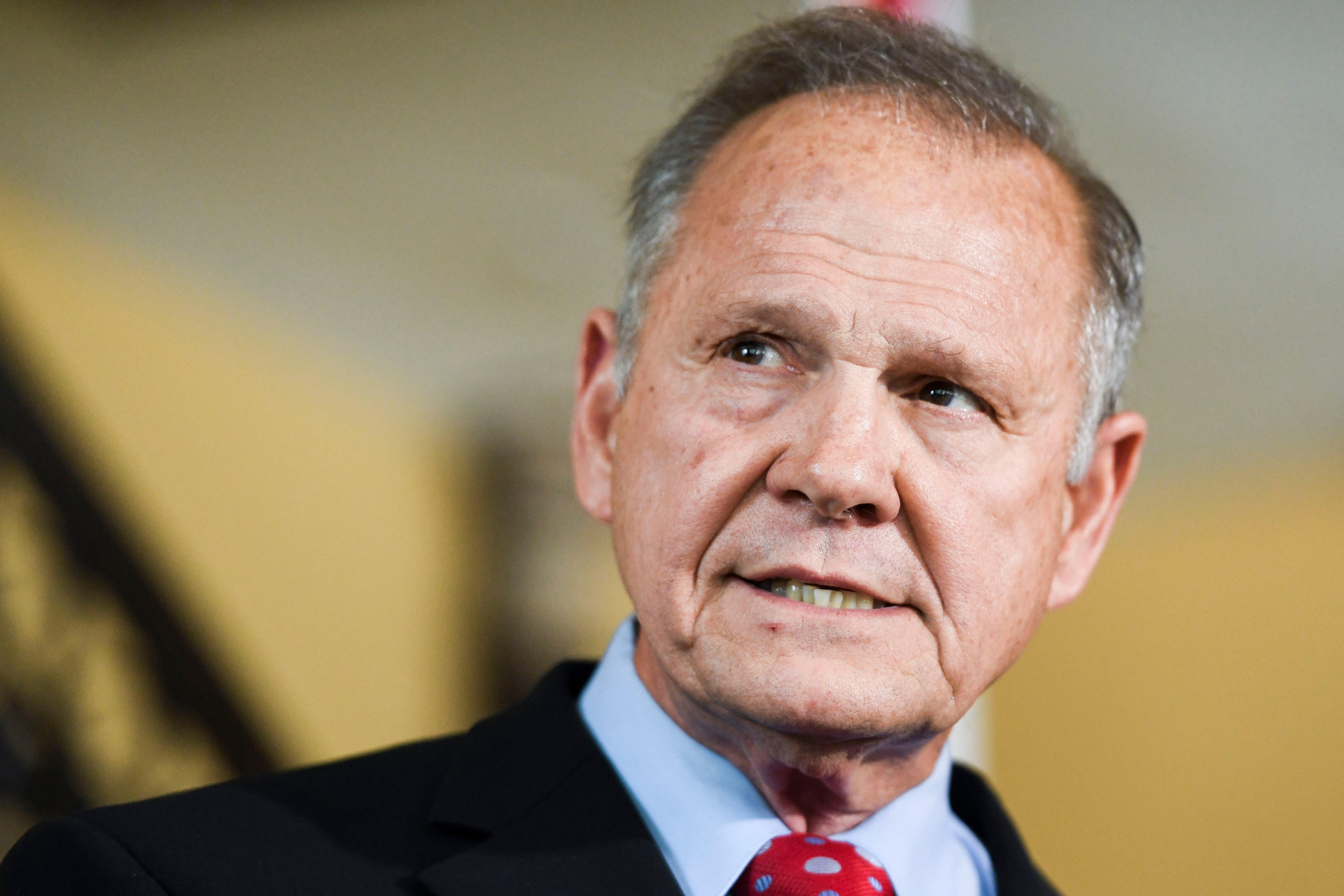
The Supreme Court on Monday declined to take up former Alabama Chief Justice Roy Moore's appeal, effectively closing the door on his long-running defamation lawsuit against a Democratic-aligned political action committee. The justices' decision lets stand a lower court ruling that had thrown out an $8.2 million jury award Moore won in 2022.
The case stemmed from television ads aired during the 2017 special election for Alabama's Senate seat. The spots, funded by Highway 31, a group backed by the Senate Majority PAC, suggested Moore had been banned from a local mall for soliciting sex from teenage girls. The ads cited news reports detailing accusations from several women, including one who said Moore initiated a sexual encounter when she was 14 and he was in his 30s. Moore has consistently denied the allegations.
Moore, who was the Republican nominee for the seat vacated by Jeff Sessions, lost the election to Democrat Doug Jones. He subsequently sued the PAC and related entities for defamation and invasion of privacy, arguing the commercials were misleading and falsely implied he had solicited sex from a minor.
An Alabama jury initially sided with Moore, awarding him $8.2 million. But a three-judge panel of the 11th U.S. Circuit Court of Appeals reversed that verdict, finding Moore had not met the actual malice standard established in New York Times v. Sullivan. That standard requires public figures to prove a publisher knew a statement was false or acted with reckless disregard for the truth.
In their petition to the Supreme Court, Moore's lawyers argued the ruling had broader implications for modern political advertising. They wrote that political ads are often built from excerpts of statements, and that if a publisher can escape liability by accurately quoting fragments while creating a false overall impression, the protections of Masson v. New Yorker Magazine—a 1991 precedent concerning altered quotes—would be undermined.
The Senate Majority PAC did not file a response to Moore's petition, and the justices offered no explanation for their decision. The move is the latest in a series of high court actions this term on politically charged cases, including climate litigation and other disputes.
Legal observers note that the refusal to hear Moore's appeal underscores the difficulty public figures face in winning defamation suits, particularly when the disputed statements are based on published news reports. The decision also reinforces the high bar set by Sullivan for proving actual malice, a standard that has been under renewed scrutiny from some conservative justices.
Moore, who has had a contentious political career—including being removed from the Alabama Supreme Court twice—has not indicated whether he will pursue further legal action. His defeat in the 2017 Senate race marked a rare loss for a Republican in Alabama, and the case has been closely watched by campaign finance and First Amendment advocates.
The Supreme Court's decision effectively closes the case, leaving the 11th Circuit's ruling in place. It also serves as a reminder of the legal protections afforded to political advertisers, even when their messages are sharply critical of public figures.