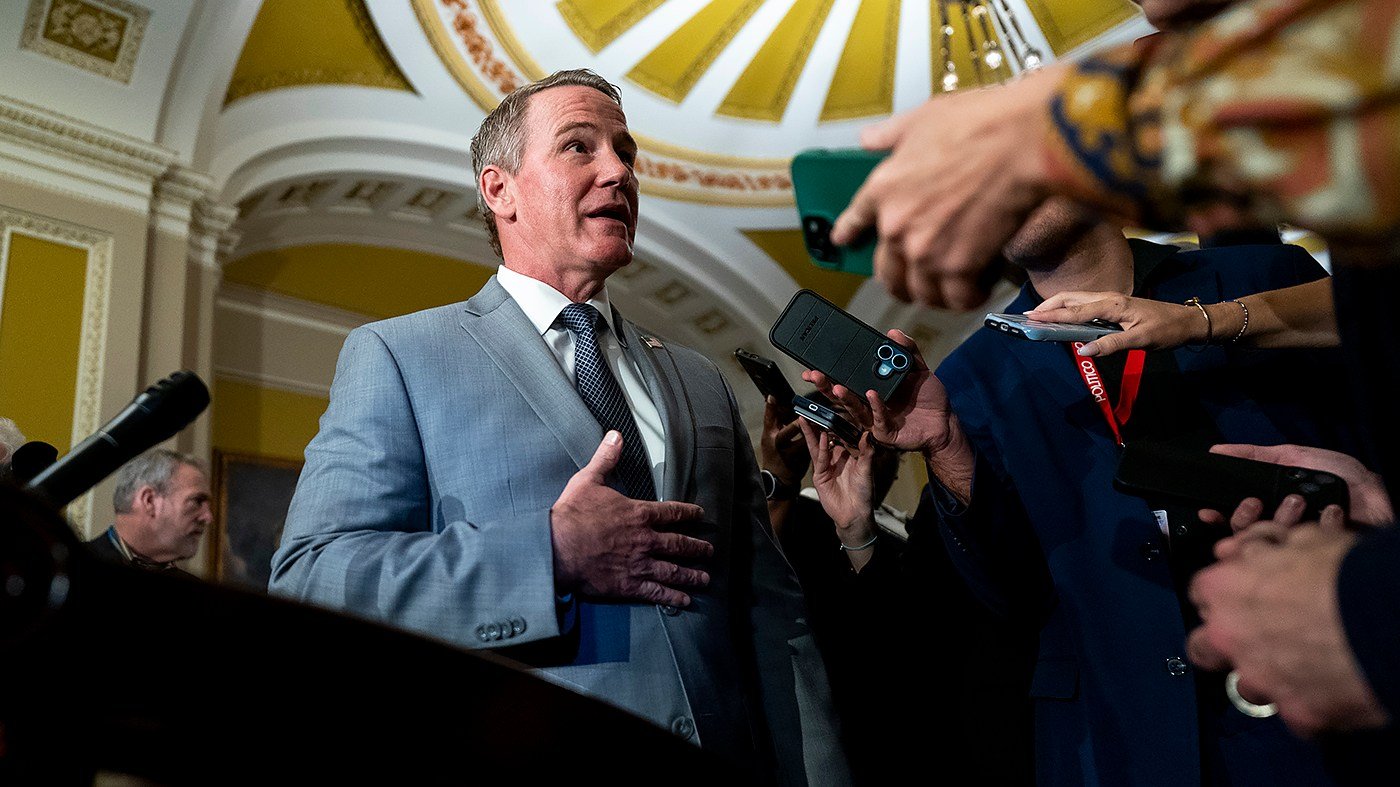
Republicans are growing increasingly concerned that data centers are becoming a political liability in the midterms, as voter anxiety over rising electricity bills tied to these facilities turns into a pocketbook issue. The tension was on full display Wednesday when Senate Democrats blocked a bill championed by Sen. Jon Husted (R-Ohio), who is locked in a competitive reelection fight against former Sen. Sherrod Brown (D-Ohio). The legislation would have required states and some electric utilities to adopt a standard ensuring data centers pay for the additional costs their massive power consumption imposes on the grid.
The legislative setback leaves Republicans in a difficult spot: they must address voter anger over data centers while navigating the White House's enthusiastic embrace of the industry. President Trump, during a Tuesday meeting with tech CEOs, touted data centers as "going to be very popular." That stance, GOP strategists say, only complicates the party's messaging. "I just think that when the president weighs in on something and says something has to be good, or 'We all are going to like them' — that muddles things a little bit, right?" said GOP strategist Amy Koch. "It's hard to be nuanced with a president who has no nuance."

Lawmakers are expected to try again on legislation to keep data center energy costs from being passed on to consumers, but action is unlikely before the November elections. The delay underscores how politically volatile the issue has become. "Politicians in both parties are now figuring out that the voters expect them to either oppose data center expansion or to have some very, very serious checks on how they're going to be built out," said GOP analyst Rob Stutzman. "It is a box that has to be checked correctly, or it can be disqualifying to voters."
For Republicans, the White House's position compounds the challenge as they fight to hold their congressional majorities. Democrats are projected to gain seats in the House and potentially the Senate, fueled by anger over the cost of living and the Trump administration's record. The issue is not confined to Ohio. In New York, Democrat Cait Conley attacked Rep. Mike Lawler (R) during a debate for not supporting a moratorium on data centers. Lawler's campaign manager, Ciro Riccardi, countered that the congressman "believes local residents should decide what gets built in their community" and that municipalities should use every tool to protect residents' quality of life and keep costs off ratepayers.
Lawler represents a battleground district rated as a toss-up by the nonpartisan Cook Political Report. The NRSC, in an August memo obtained by NewsNation, warned that data centers are "the anchor hanging around Husted's neck." The memo noted that Brown's messaging "is significantly more effective than traditional messaging tracts, as it introduces new information on a highly relevant, emerging topic. This has become a sleeper issue for the entire election cycle."
Some Republicans are trying to strike a nuanced tone, similar to their approach on artificial intelligence — avoiding a rush to regulate while acknowledging the costs to communities. "I think the Republican approach to it — setting aside Trump saying everyone's going to like data centers — no one's going to like data centers. That's silly," Koch said. "But understanding that there is a need for data centers, and let's do it in a way that's smart. Let's do it in a way that's innovative. Let's push the companies to make sure that when they're putting them up, they're well needed, that they're actually needed, that they're doing them in a way that is responsible."
Other Republicans highlight the economic benefits. Rep. Rich McCormick (R-Ga.), expected to cruise to victory in his ruby red district, told Newsmax that "if you don't want a data center, that's fine, don't have one." But he argued they bring jobs, lower electricity rates, and fund schools and roads. "It's going to be an amazing thing to have in your neighborhood," he said.
The political fallout is especially acute in Ohio, where Brown has hammered Husted over his support for data center tax breaks during his tenure as lieutenant governor, calling him "the point man to bring these data centers to Ohio." The NRSC memo warned that if Husted loses and data centers get the blame, "politicians across the country will take notice — and they will not go near the next one."
As the midterms approach, the data center debate is likely to intensify, with Democrats using it to attack Republicans and Republicans scrambling to find a message that reassures voters without alienating an industry the White House champions. The outcome could shape not only this election but the future of data center policy in Washington.