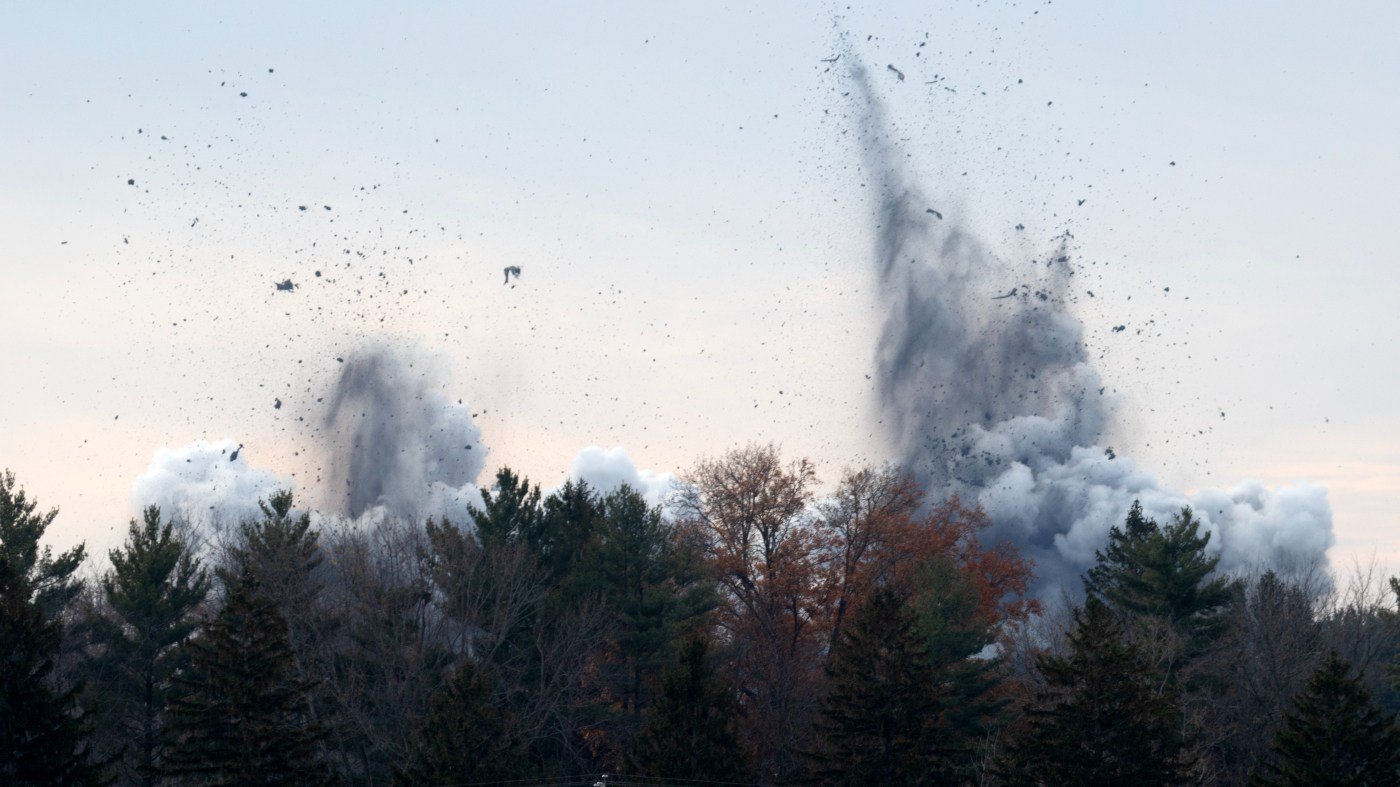
The Environmental Protection Agency announced Saturday that initial lab results from water samples taken after the U.S. Army's controlled munitions detonation in Iowa showed no elevated lead levels in drinking water supplies.
In a press release, the EPA stated that "no lead" was detected in 38 samples collected post-detonation from public water systems, including both finished treated water and raw water at intake points. The samples were taken from locations in Iowa, Illinois, and Missouri.

The Army carried out the controlled explosion of more than 60 barrels of lead azide munitions at the Iowa Army Ammunition Plant in Middletown on Wednesday, an operation that had been contested by environmental groups and some lawmakers over potential health risks.
Before the detonation, the EPA had collected 35 water samples from the same tri-state area to establish a baseline. The agency noted that some water bodies, such as Mark Twain Lake, the Illinois River, and the Mississippi River, already contained low levels of lead prior to the blast, but those levels were within the agency's safety standards for drinking water.
"The lead was present in the samples prior to Wednesday's controlled detonation, and, therefore, not caused by the explosion," the release stated.
The EPA has been conducting ongoing monitoring of air, water, soil, and dust in the surrounding region, with field teams gathering samples from parks, playgrounds, schools, churches, and other public spaces. The agency also reported that no airborne lead particles had been detected immediately after the explosion.
Acting Army Secretary Adam Telle praised the operation as a "success," echoing other Trump administration officials who argued the blast was necessary to prevent the risk of an "accidental, uncontrolled detonation" of the deteriorating munitions. The decision to proceed, however, had drawn sharp criticism, including from House Minority Leader Hakeem Jeffries, who called the handling of the situation "grossly incompetent." Jeffries's remarks added to the political friction surrounding the operation.
Environmental groups had sued to halt the detonation, arguing it could release lead dust into the air and expose nearby communities to toxic particles. Lead is particularly hazardous to children and can cause developmental and neurological damage, according to the EPA.
The controversy was further fueled by the short notice given to local officials and residents, prompting some Iowa lawmakers to protest. The Army had initially delayed the operation after those objections, but ultimately went forward. The delay and subsequent backlash highlighted the tensions between military necessity and public safety.
In its Saturday statement, the EPA pledged to "continue to communicate transparently with the public as more data is received and validated." The agency's findings are likely to inform the ongoing debate over the safety of such munitions disposal operations.
As the EPA continues its analysis, the political and legal battles over the detonation are far from over. The lawsuit filed by Iowa environmental groups remains a focal point, and the full environmental impact of the blast may not be known for some time. The EPA's initial water results offer some reassurance, but the broader concerns about air and soil contamination remain under scrutiny.