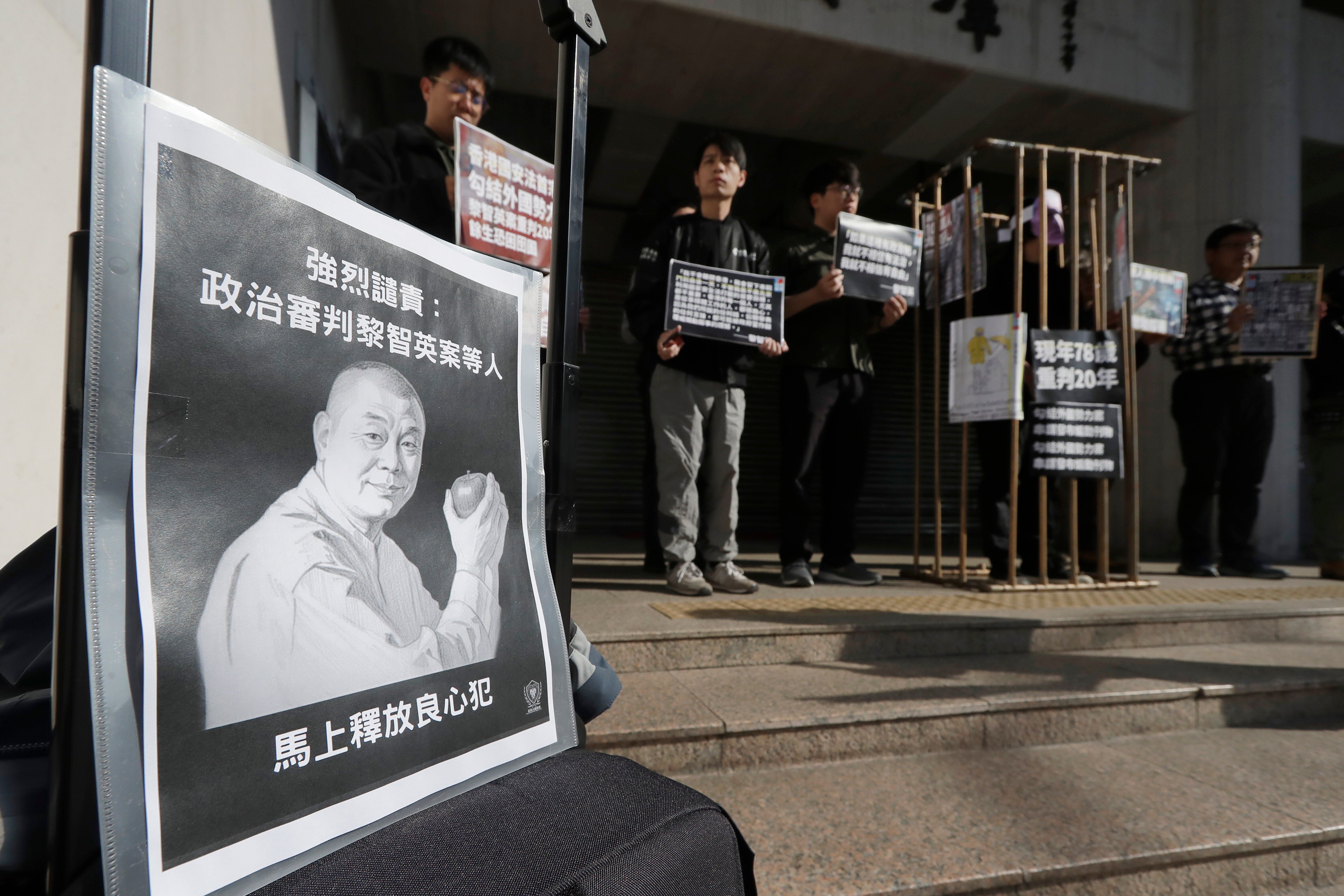
When Xi Jinping arrives in Washington on September 23, President Donald Trump will have a rare opportunity to deliver on a promise he made with characteristic certainty: to free Jimmy Lai, the Hong Kong media proprietor and democracy advocate who has been behind bars since 2020.
Lai, 78, is not a household name in every American home, but to those who track the erosion of Hong Kong’s freedoms, he is a defining figure. A self-made newspaperman who founded the feisty, pro-democracy tabloid Apple Daily, Lai built a media empire that routinely skewered the Chinese Communist Party. That made him a target. Since his arrest under the sweeping national security law imposed on Hong Kong in 2020, he has spent much of his incarceration in solitary confinement, his health deteriorating as he suffers from diabetes.
Trump, who in 2020 was described by Lai as “the only one who can save us” from Beijing’s tightening grip, later vowed to get Lai out “100 percent.” It would be easy, he insisted. Now, with Xi in Washington, that boast faces its moment of truth. Releasing Lai would cost Beijing little. Keeping him locked up ensures he remains a global symbol of the party’s fear of dissent.
The case against Lai was never really about the law. Strip away the legal scaffolding and the reality is stark: Lai is in prison because he published a newspaper that Beijing could not tolerate. Apple Daily was noisy, irreverent, and fiercely critical of the CCP—precisely the kind of independent journalism that an authoritarian system views as an existential threat. The response was ruthless: Lai was prosecuted, his colleagues targeted, and the paper forced to shut down. The message to every editor, reporter, and citizen in Hong Kong was unmistakable: this could be you.
That is how modern censorship works. It rarely involves a bureaucrat simply striking out offending words. Instead, it uses national security laws, arrests, prosecutions, and the threat of prison to make people censor themselves. Hong Kong, once one of Asia’s freest media environments, has been dismantled with astonishing speed. Lai’s continued imprisonment is both a measure of that loss and a warning to others.
Yet for all his symbolic weight, Lai is also an elderly man with diabetes who, according to his daughter Claire, no longer wishes to continue his activism. He wants to spend his remaining years in peace with his family and his faith. His son Sebastien has spoken of introducing Lai to his grandchildren. Another of his children is battling cancer. His wife, Teresa, waits for him. These are ordinary wishes, not revolutionary demands.
Trump has shown that when he makes a political prisoner a diplomatic priority, results can follow. His administration helped secure the release of prominent detainees in Belarus, including Sergei Tikhanovsky, the most high-profile opposition leader locked up by Aleksandr Lukashenko. There is no reason the same pressure cannot be applied to Beijing—especially when Xi is on American soil, basking in the prestige and pageantry afforded to a superpower.
The question Trump should ask Xi is simple: What kind of global superpower feels so threatened by a 78-year-old newspaperman that it must keep him in a cell? The answer, of course, is one that fears ideas more than armies. Releasing Lai would cost Beijing almost nothing. Keeping him imprisoned guarantees that he remains a living indictment of the regime’s intolerance.
For those who have followed Lai’s ordeal—including the journalists and free-speech advocates who have published his letters and chronicled his life—the imagined reunion with his family has been a long time coming. There is hot chocolate waiting. All Trump has to do is ask.