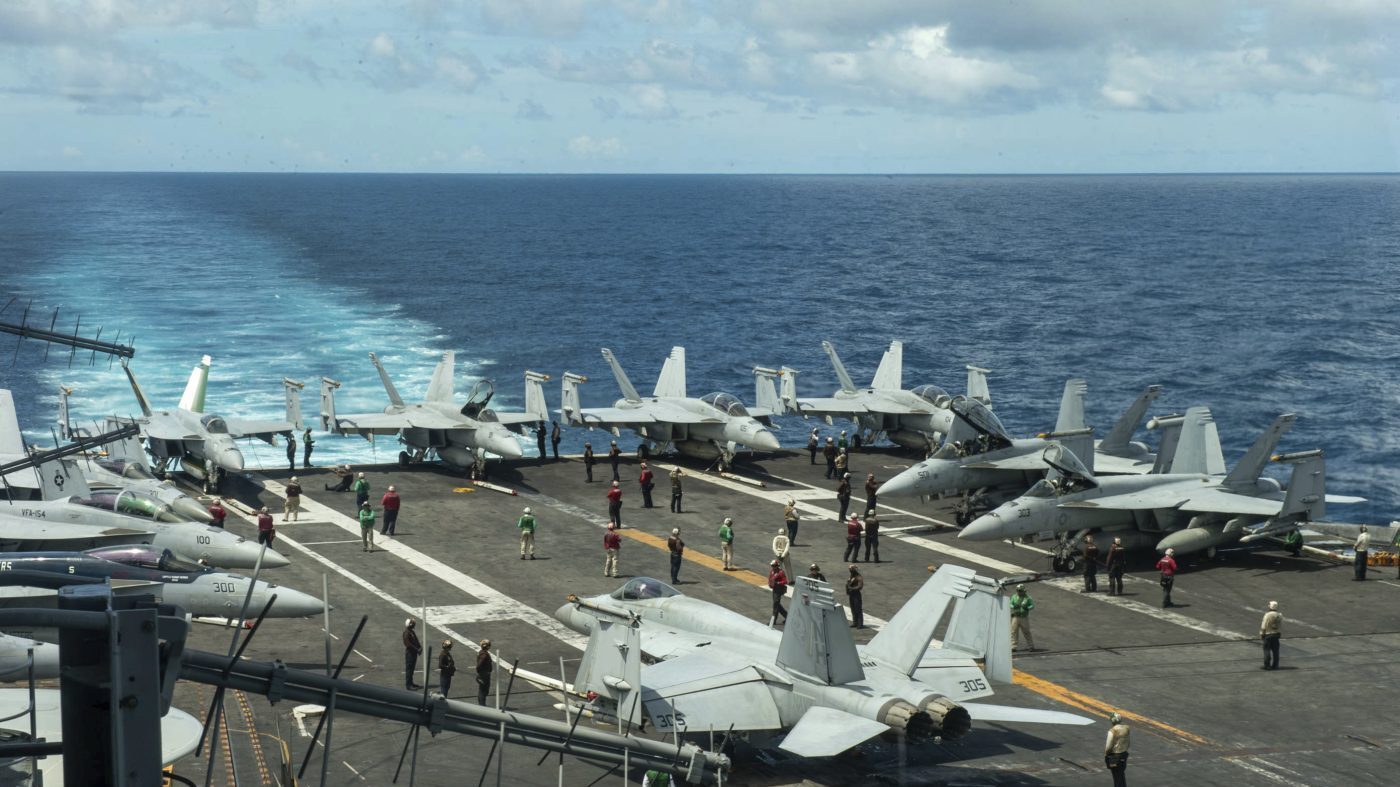
The USS Theodore Roosevelt, a Nimitz-class aircraft carrier, departed San Diego on Sunday bound for the Middle East, where it will take over duties from the USS George Washington, according to ship-tracking outlet WarshipCam. The Roosevelt, which serves as the flagship of Carrier Strike Group 9, will relieve the Japan-based George Washington, which was sent to U.S. Central Command’s area of responsibility last month.
The Navy did not immediately respond to a request for comment from The Hill.
The deployment comes as Washington continues to prioritize the free flow of oil through the Strait of Hormuz and maintains a naval blockade in the Arabian Sea. Since July, U.S. forces have redirected 122 commercial vessels to ensure compliance with the operation, Centcom said in a Friday update. Military officials say more than one billion barrels of oil have transited the strategic waterway in recent months.
The U.S. has kept at least one aircraft carrier in the Centcom region since President Trump escalated the conflict with Iran in late February. The other carrier currently operating in the Middle East is the USS George H.W. Bush. The George Washington was originally dispatched to replace the USS Abraham Lincoln, whose extended deployment drew criticism from Democratic lawmakers and sailors’ families following reports of poor conditions onboard and deteriorating mental health among the crew.
Chief of Naval Operations Adm. Daryl Caudle acknowledged last month that the sustained operations have placed significant strain on the force. “We’ve been in conflict pretty much the whole time I’ve been in the seat, and that’s certainly stressed the force,” Caudle told reporters. “I’m trying to work with my chain of command to put the extension process in a way that gives more certainty for planning.”
He added that the Navy needs to provide better timelines for carrier deployments, especially when heading into dangerous areas. “If we know we’re going into harm’s way, we should be able to project with a little bit more fidelity how long the carrier and the strike group is going to stay on station,” he said. “We do these extensions in little chunks, and the families don’t see any endpoint so they can plan their own lives. That creates a lot of stress for sailors.”
The Roosevelt’s deployment underscores the Pentagon’s ongoing commitment to maintaining a robust naval presence in the region, even as it grapples with the logistical and human costs of prolonged operations. As the U.S. continues its pressure campaign against Iran, the carrier swap ensures that a powerful strike group remains on station to deter aggression and protect vital shipping lanes.
The move also highlights the broader geopolitical stakes, with the U.S. seeking to balance its military posture amid other global challenges. The Biden administration has faced scrutiny over its handling of the Middle East, but officials insist that the carrier presence is necessary to safeguard international commerce and regional stability.
As the Roosevelt makes its way to the Middle East, the Navy will be watching closely to see if the deployment proceeds without incident. The ship’s arrival will mark another chapter in the U.S. military’s long-running engagement in the region, one that shows no signs of winding down.