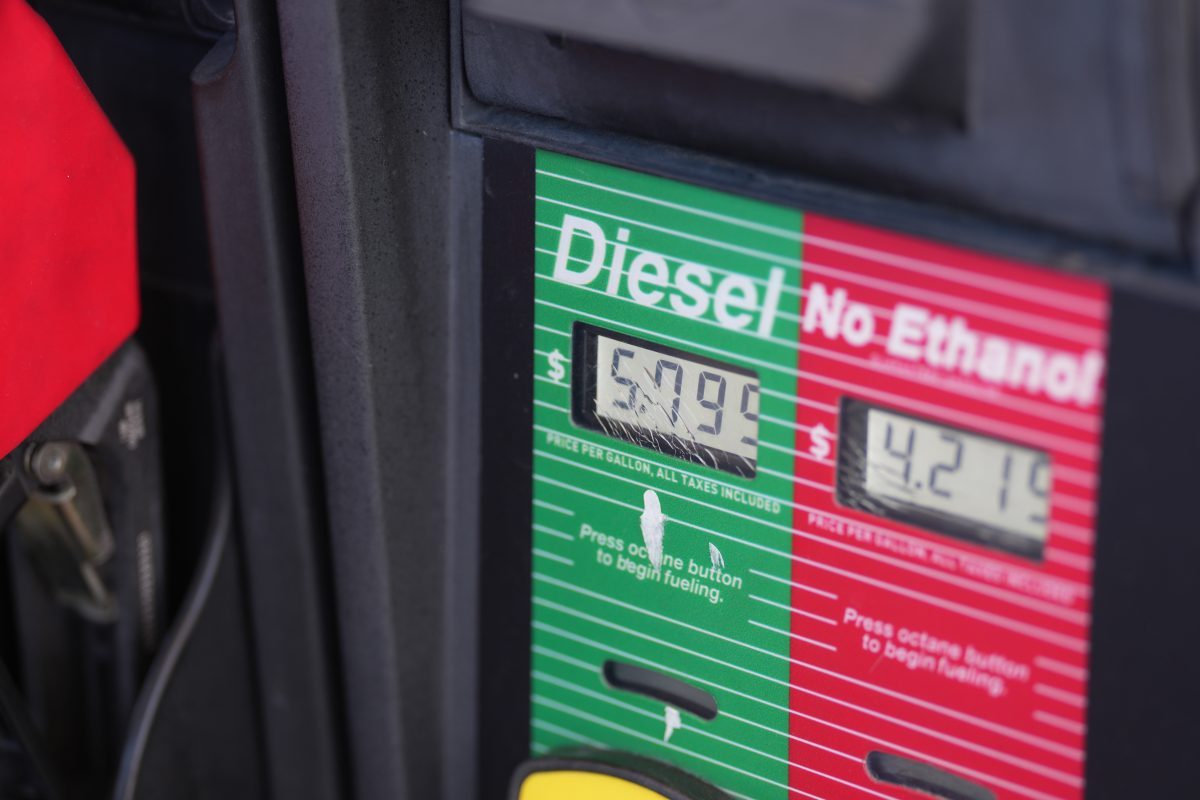
President Trump on Monday signed an executive order to broaden the use of red-dyed diesel, a move designed to ease the financial burden on truckers and other diesel consumers amid persistently high fuel prices. The order, which defers federal excise taxes on the fuel for the remainder of the year, is part of a broader push to reduce costs. However, experts caution that the actual savings may be modest and that implementation faces significant hurdles.
Red-dyed diesel is simply diesel fuel with a red dye added to indicate that it is exempt from state excise taxes and the federal tax of 24.4 cents per gallon. The dye serves as a law enforcement tool, allowing authorities to identify illegal on-road use and enforce penalties and back taxes, according to a White House fact sheet.

While red-dyed diesel is already used by farmers for off-road equipment and by industries such as construction and marine operations, its expansion to on-road use is new. Trump's order specifically calls for a deferral of the federal excise tax on dyed diesel used on highways, with the possibility of eliminating the obligation entirely. The White House claims that a typical trucker could save more than $100 per fill-up.
However, industry analysts are skeptical. Tom Kloza, chief oil analyst at Gulf Oil, told The Hill that the move is "really a cosmetic gesture" and a "Band-Aid where a tourniquet would be more appropriate." He argues that increasing the availability of red-dyed diesel will not significantly affect overall fuel prices.
Patrick De Haan, a fuel price analyst at GasBuddy, echoed those concerns on social media, noting that "most major truck stops don't sell dyed diesel" and that "states have their own dyed diesel laws, and an [executive] order can't override them." He also pointed out that the federal tax is merely "deferred," not eliminated, and that supply, not taxes, is the primary driver of diesel prices.
The executive order does not automatically expand availability at retail stations. While some commercial fuel card companies offer maps of stations selling dyed diesel, coverage is uneven, with several states lacking locations. The Commercial Fueling Network's map, for example, includes some stations in Rhode Island and Connecticut, but the C NRG Fleet map does not list any in those states or in Massachusetts, Alaska, or Hawaii.
Several states have already taken action to expand red-dyed diesel use. Texas recently allowed its use on highways for truckers and farmers, and Indiana suspended restrictions for agricultural and timber operations. Other states, including Oklahoma, North Dakota, North Carolina, Nebraska, Missouri, Louisiana, Arkansas, and Alabama, have also made moves regarding dyed diesel. But as De Haan noted, state-level taxes on dyed diesel still apply, such as North Dakota's 4 cents per gallon.
The executive order is part of a broader political strategy to address fuel costs ahead of the midterm elections, but critics argue it is more symbolic than substantive. As the White House continues to tout the potential savings, the practical impact remains uncertain, and truckers may still find it difficult to locate red-dyed diesel at their usual fueling stops.
For now, the order represents a significant policy shift, but its real-world effects will depend on how quickly and broadly fuel stations and states adapt. As the administration pushes forward, the debate over fuel taxes and supply will likely intensify.

