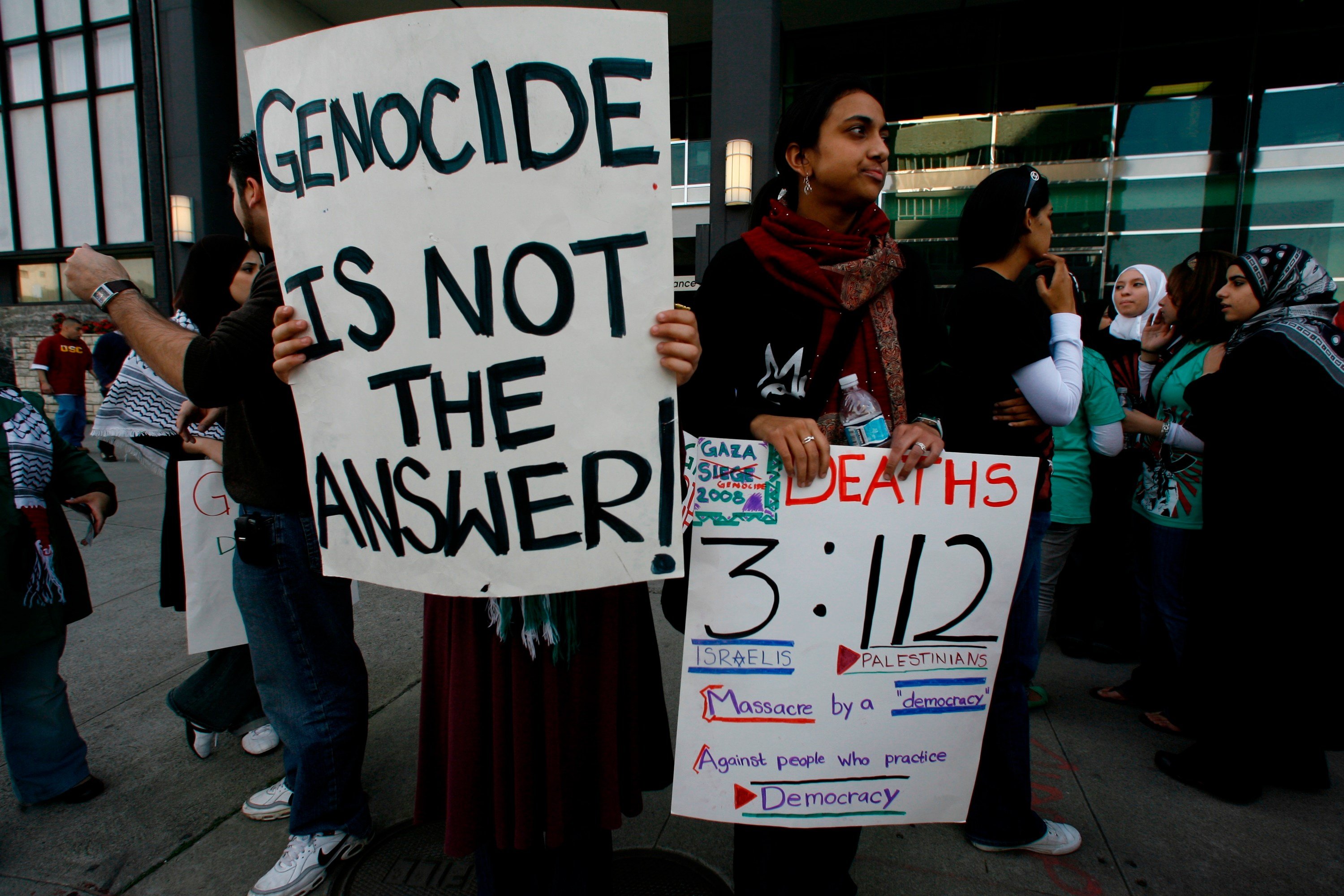
The distinction between a just war and genocide is not merely academic—it is central to how the international community judges conflict. While every war invites scrutiny under just war theory, the accusation of genocide carries a specific legal and moral weight that should not be applied selectively. Yet critics argue that Israel is being singled out for this charge in a way that no other nation facing similar circumstances has been.
Israel's military campaigns against Hamas and Hezbollah are, by most reasonable assessments, exercises in self-defense following the October 7, 2023, massacre. Like any war, they are subject to debate over tactics, proportionality, and individual decisions. But even if one concludes that Israel has violated just war principles, that does not automatically transform its actions into genocide. The two concepts are distinct: genocide requires intent to destroy a people, not merely the tragic reality of civilian casualties.

History illustrates this point. During the Normandy campaign, Allied bombing killed approximately 50,000 French civilians, and historians have questioned whether every aspect of that operation met just war standards. Yet no serious person has ever accused the Allies of genocide against the French. Civilian deaths, even on a devastating scale, are not proof of genocide. This principle should apply equally to Israel.
The selective application of the genocide label is not a legal argument but a political weapon. When one nation is singled out for an accusation reserved for no one else facing comparable circumstances, the motive is no longer the pursuit of justice. It is the delegitimization of the world's only Jewish state. This double standard is a form of antisemitism, as argued by Dan Pollak, director of government relations for the Zionist Organization of America.
Consider the context: the Assad regime has killed hundreds of thousands of Syrians, China has persecuted the Uyghurs, and mass atrocities have occurred across Africa and elsewhere. Yet the genocide label is rarely weaponized against these actors with the same intensity as it is against Israel. The difference, critics argue, is that Israel is a Jewish state defending itself, and the accusation is designed to strip it of legitimacy.
Some point out that Jews themselves sometimes use this rhetoric, or that members of Congress have embraced it. But neither fact changes the nature of the accusation. Jewish history has never been free of those willing to turn against their own people, and elected office has never been a safeguard against prejudice. Popularity does not transform a false accusation into a true one.
The political power of the genocide label is precisely why it is used. It recasts Jewish self-defense as criminality and portrays Israel as uniquely evil. Throughout history, those seeking to isolate the Jewish people have adapted the language of their era to achieve that goal. Today, the word 'genocide' has become their preferred weapon.
There must be a public price for promoting this falsehood, Pollak argues. The first step is calling it what it is: hatred directed at Jews. This is not about semantic debates over the definition of antisemitism or the evolution of the word 'Semite.' It is about the discriminatory double standard that applies a uniquely damaging accusation to Israel alone while judging every other nation by a different standard.
For those genuinely interested in understanding why Israel's conduct does not constitute genocide, the work of urban warfare expert John Spencer is instructive. But for those who continue to apply the genocide label exclusively to the Jewish state despite the facts, the choice is political, not legal. The days when the Jewish people were expected to accept such slanders in silence are over.