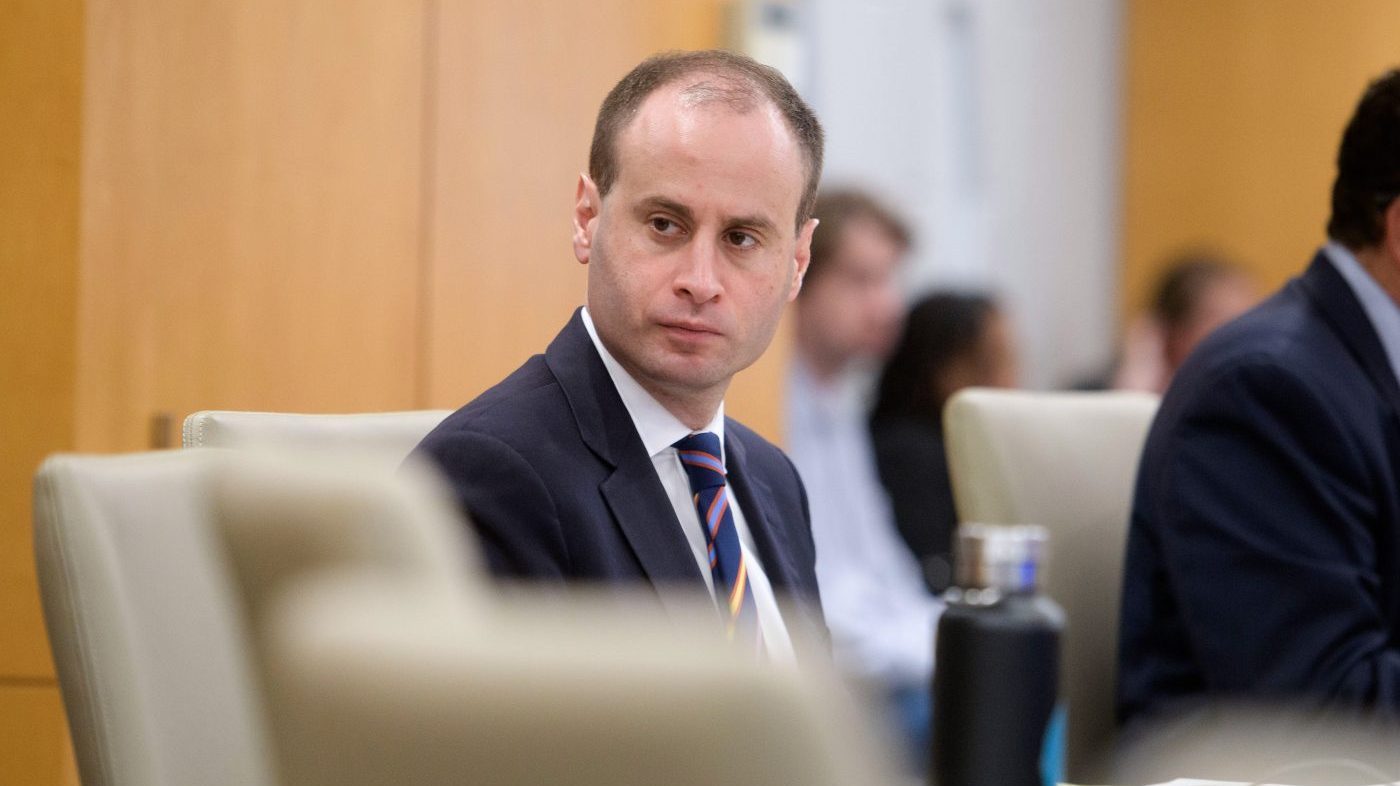
White House counsel Will Scharf on Thursday hailed the Supreme Court’s June decision expanding presidential removal power as a “generational win,” arguing it repaired what he described as a long-standing constitutional error.
Speaking at the Federalist Society’s annual National Lawyers Convention in Washington, Scharf said the 6-3 ruling in Trump v. Slaughter—which permitted President Trump to dismiss Federal Trade Commissioner Rebecca Slaughter, a Democratic appointee—restored the president’s ability to control the executive branch.
“A president who can’t control who’s exercising the executive power that is vested in him, that’s a cabined presidency,” Scharf said, according to prepared remarks. He added that the decision overturned a “very, very poor and quite ancient precedent.”
The ruling held that the president may fire the heads of most independent federal agencies at will, discarding a nearly century-old framework that had insulated those bodies from direct political pressure. The court’s conservative majority sided with the Trump administration, while the three liberal justices dissented.
Scharf, who has previously signaled that the White House would aggressively defend its prerogatives, praised the justices for what he called a “masterful job” and said they “really got it right.” His comments underscore the administration’s broader push to consolidate executive authority and reshape the federal bureaucracy.
The decision has sweeping implications for agencies such as the Federal Trade Commission, the Securities and Exchange Commission, and the National Labor Relations Board, which have historically operated with a degree of independence from the White House. Under the new precedent, presidents of both parties will have far greater latitude to remove commissioners whose policy views diverge from their own.
Critics warn that the ruling could politicize agencies that regulate everything from financial markets to consumer protection, making them more responsive to electoral swings. Supporters counter that the Constitution vests all executive power in the president and that independent agencies have long been an unconstitutional anomaly.
Scharf’s remarks come as the administration continues to test the boundaries of executive power, including in ongoing oversight battles with Congress. The White House counsel has vowed a legal war over Democratic probes, signaling that the president will not cede ground on separation-of-powers disputes.
While the immediate case involved a single FTC commissioner, the ruling’s reach extends to dozens of multimember boards and commissions. Legal scholars expect a wave of litigation as new administrations test how far they can go in replacing holdover officials.
For now, Scharf and his allies are framing the decision as a landmark restoration of Article II authority—one that could define the relationship between the White House and the administrative state for decades to come.