The furor over Macklemore's onstage call for a free Palestine at an Ed Sheeran concert has become a flashpoint in the ongoing clash between free speech principles and the realities of private ownership. But a closer look at the episode suggests that, contrary to the outrage, the system largely functioned as intended—albeit with uncomfortable ironies about who gets defended and who gets silenced.
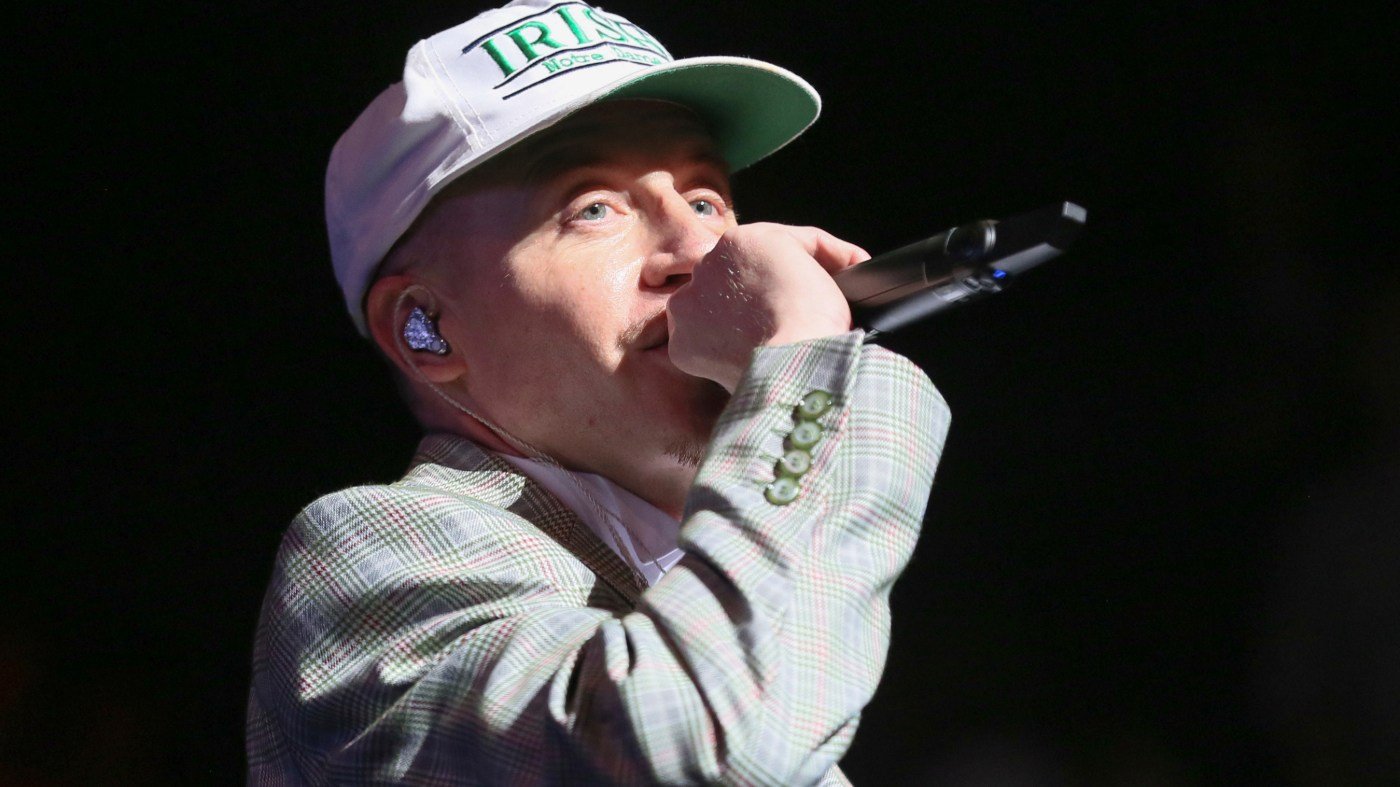
Earlier this month, Macklemore, the opening act for Ed Sheeran at MetLife Stadium in New Jersey, interrupted his set to repeatedly shout "Free Palestine," urging the audience to spread the message "from Gaza all the way to the occupied West Bank." The stadium's massive screens then displayed a video montage of devastation in Gaza and footage of campus protests. The crowd's reaction was muted—some cheered, but most remained silent. Offline, however, the clip went viral, drawing sharp criticism from Israel supporters who decried the performance as one-sided.
The backlash quickly moved from social media to the executive suite. Robert Kraft, owner of the NFL's New England Patriots and Gillette Stadium, threatened to cancel an upcoming Sheeran show unless Macklemore was dropped from the lineup. Other venue owners joined the demand. Sheeran's promoter, the Messina Group, a private company, capitulated and removed Macklemore from the tour. In response, all four of Sheeran's other supporting acts quit in protest, and other musicians publicly condemned what they called the silencing of Macklemore.
Legally, the First Amendment does not compel Kraft to allow his property to be used for speech he finds objectionable. As a private owner, he has every right to bar Macklemore from Gillette Stadium—whether or not one agrees with his reasoning. The amendment would only apply if public stadiums, which host several future concerts, had banned Macklemore, but that has not occurred. The decision was made by a private promoter bowing to pressure.
At his next solo concert, Sheeran apologized for "making mistakes" in the incident, insisting he never wanted to be an "activist musician." He added, "What is happening in Gaza is catastrophic and unjustifiable and disproportionate. My heart has been broken by the scale of devastation and the loss of civilians' lives, of children's lives."
Free speech, however, extends beyond the First Amendment. Macklemore has lost the massive audiences on Sheeran's tour, but he remains free to rally support for Palestine elsewhere. Indeed, his message has been amplified by the many musicians who spoke out in his defense. Last week, he announced plans for his own "Free Palestine" tour, set to begin in October across Europe and the U.S. The new tour is a direct response to his removal.
The episode underscores a time-honored civil libertarian response: more speech, not less. Kraft exercised his property rights, and the counter-speech from the music community has projected Macklemore's message far beyond Gillette Stadium. But the controversy also exposes a glaring double standard. For years, pro-Palestine activists have organized boycotts and cancellations of Jewish and Israeli performers, with scant objection from the broader arts community. The Orthodox Jewish reggae artist Matisyahu has repeatedly faced canceled concerts for the apparent offense of performing under a Hebrew name. Jewish comedians have had shows canceled in the U.S. and at the Edinburgh Fringe Festival, the latter resulting in a court finding of unlawful religious discrimination. Poets, authors, and actors have been deplatformed for being deemed insufficiently anti-Israel.
None of these cases attracted even a fraction of the attention devoted to Macklemore's exclusion. Almost nobody outside the Jewish community has spoken up for these artists, some of whom were blacklisted solely for their identification with Israel or their perceived silence on Gaza. If Macklemore himself ever objected to censoring Israeli and Jewish performers, no record exists. Among musicians, free speech is often defended only for approved speakers.
Justice Sonia Sotomayor recently told a bar conference in Oklahoma that her "greatest fear" for American democracy is the "lack of quality in our teaching of civics education," specifically that people "don't understand what the First Amendment means." The Macklemore affair is a case in point. It demonstrates that free speech, in the private sphere, is often a matter of power, not principle—and that selective outrage can undermine the very values so many claim to champion. As the fallout continues, the debate over who gets to speak and who gets silenced is far from over.