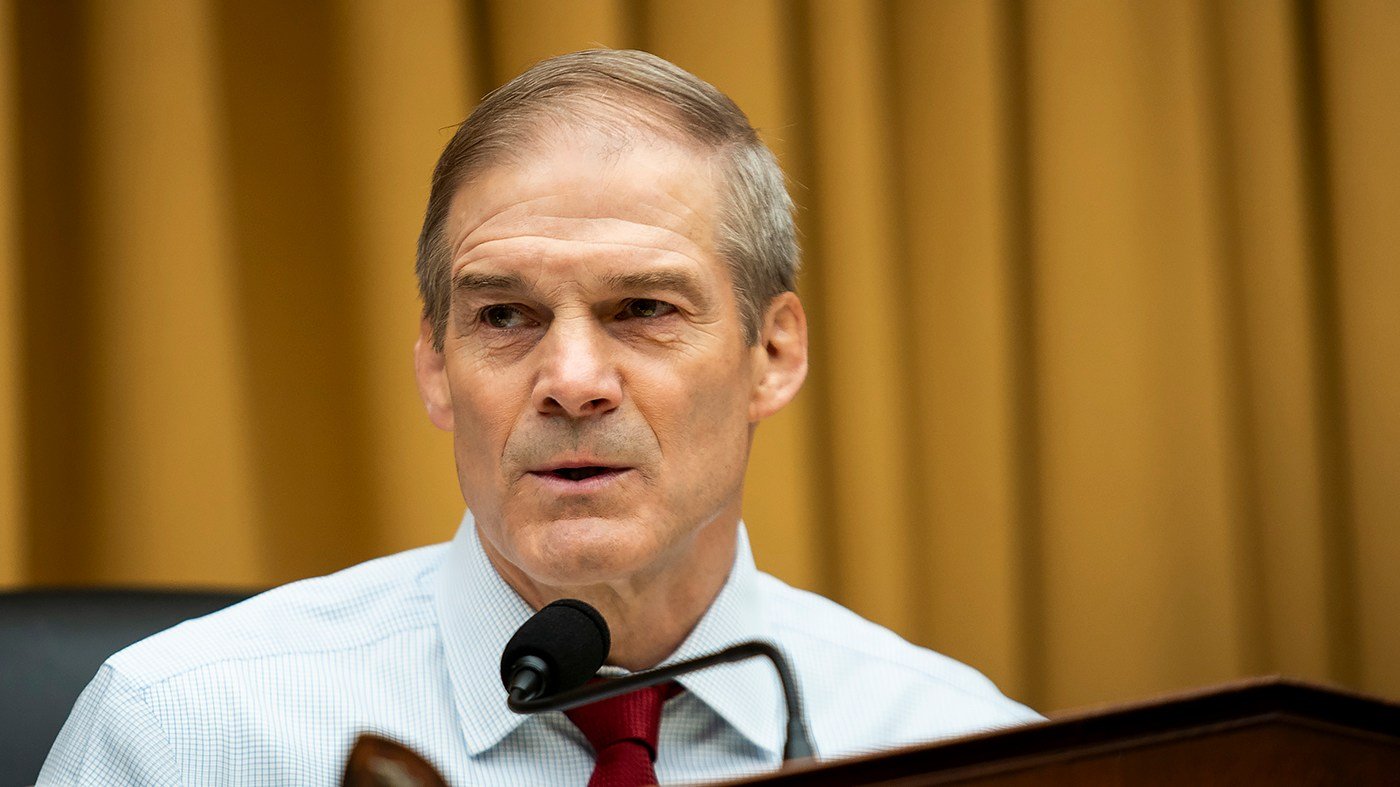
House Republicans chose Rep. Jim Jordan (R-Ohio) on Tuesday to lead their conference in the minority next year, handing a decisive victory to a founding Freedom Caucus firebrand who has spent much of his career battling the party’s leadership. Jordan defeated Rep. Steve Scalise (R-La.), the outgoing majority leader, 106-73 in a closed-door secret-ballot election at the Capitol Visitor Center.
The result marks a stunning reversal for Scalise, who has been in GOP leadership since 2014 and has served as the No. 2 House Republican since 2019. His allies had argued that his experience and relationships made him the safest choice to steer the party through its new minority status. But after Republicans suffered a bruising midterm defeat last week, a restive conference turned on its established leaders.

Much of the anger was aimed at Speaker Mike Johnson (R-La.), but Johnson is already stepping down from leadership at the end of this term. That left Scalise and Rep. Tom Emmer (R-Minn.), the GOP whip, as the most immediate targets of a “clean house” movement that spread rapidly through the conference. The GOP leadership battles have intensified as the party faces a minority reckoning.
Jordan, a 20-year House veteran, seized the moment. He campaigned aggressively for Republican candidates across the country this cycle, building goodwill among newcomers who arrived after a wave of retirements. He also positioned himself as a fresh face ready to take the fight to Rep. Hakeem Jeffries (D-N.Y.), who is in line to become Speaker, and the incoming Democratic majority.
In his Dear Colleague letter last week, Jordan warned that Republicans have too often “operated without a clear plan to survive the hour or the day in front of us.” He said that approach “will not cut it against an emboldened and energetic Democratic majority,” adding that he is “battle-tested on the oversight front” and knows “the Democrats’ playbook.” Jordan also pledged a leadership team that is “active and engaged, forward-thinking and straight-shooting.”
Jordan’s rise is remarkable given his history as an antagonist of party leaders. As the first chairman of the House Freedom Caucus, he helped build a bloc that gained influence by attacking Republican speakers, including John Boehner, whom conservatives viewed as too eager to compromise. Under pressure from the group, Boehner resigned in 2015. But Jordan later shifted toward the establishment, backing Rep. Kevin McCarthy (R-Calif.) for Speaker after initially opposing him in 2015. That pivot helped Jordan ascend to chair the Judiciary Committee and win the top GOP spot on the Oversight Committee. McCarthy, who has long feuded with Scalise, lobbied on Jordan’s behalf in Tuesday’s race.
Jordan has also moved toward the center on some policy issues, most notably by supporting President Trump’s efforts to expand warrantless surveillance powers he once opposed. His contest with Scalise was a rematch of their 2023 Speaker fight: Scalise won the initial nomination but withdrew when he could not secure 218 votes on the floor, and Jordan later became the nominee but also fell short, leading to Johnson’s eventual election.
Now Jordan will have to hold together a diminished conference. Democrats are on track to control roughly 260 seats next Congress, a commanding majority that will give Jeffries room to advance his legislative priorities. Democrats are also preparing exhaustive investigations into Trump, his family, and his administration, making Jordan the first line of defense for his ally in the White House. As Scalise has urged GOP chairs to prepare for a Democratic probe wave, Jordan will need to coordinate a unified response.
Updated at 2:25 p.m. EST