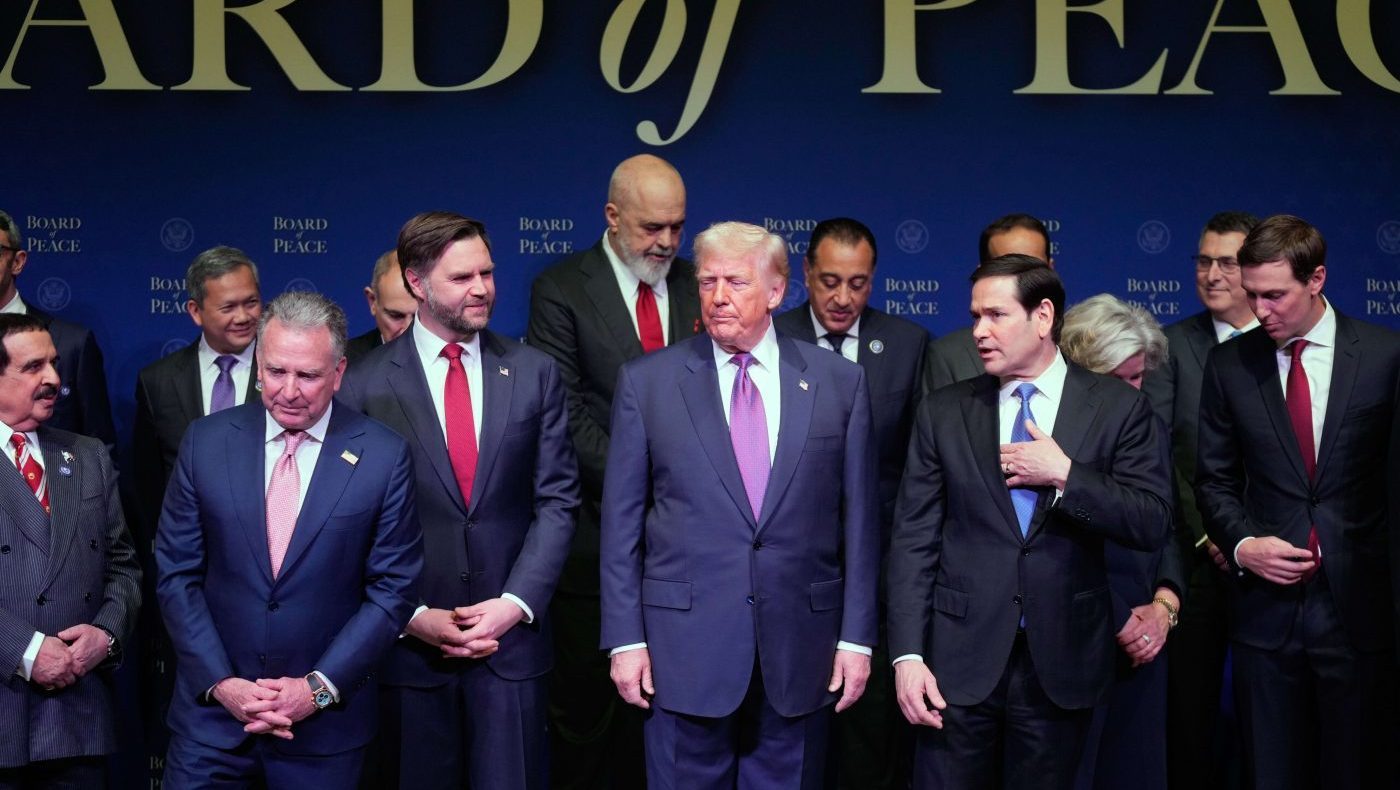
House Democrats are escalating their scrutiny of President Trump’s Board of Peace, demanding that Secretary of State Marco Rubio explain how the administration is handling taxpayer money and whether the board could become a vehicle for personal enrichment. In a letter sent Tuesday, obtained exclusively by The Hill, ranking members of the House Judiciary and Foreign Affairs Committees, Reps. Jamie Raskin (D-Md.) and Gregory Meeks (D-N.Y.), pressed Rubio on the board’s structure, funding, and oversight, nine months after its creation.
The letter comes after the Trump administration was forced to halt a $50 million transfer to the board in July, following lawmakers’ objections that the State Department could not answer basic questions about the board’s operations. Democrats argue that the board, which Trump established in October as part of his plan to end the Gaza conflict, is an opaque entity prone to corruption. “The fact that the Trump Administration, with your help, is attempting to transfer taxpayer dollars to the Board of Peace, an opaque organization primed for corruption, raises serious concerns that public funds could be once again misused by the President and his family and friends,” the lawmakers wrote.
Trump appointed himself as “chairman for life” of the board, giving him apparent unilateral control over decisions and spending on Gaza reconstruction, even beyond his presidency. The United Nations Security Council endorsed the board until 2027, but Trump expanded its mission in January to address global conflicts, positioning it to outlive that deadline. He has solicited billion-dollar pledges from countries in exchange for lifetime membership and promised an initial $10 billion from the U.S. government.
A board official told The Hill that hundreds of millions of dollars have been collected for the Gaza Peace plan, with donors preferring to place funds in a bank account managed by J.P. Morgan rather than the World Bank, as reported by the Financial Times. Democrats and critics say there are no clear answers on who is auditing that account. The State Department’s July 29 notification to Congress about rescinding the $50 million transfer followed intense pressure from Sen. Jeanne Shaheen (D-N.H.), ranking member of the Senate Foreign Relations Committee, according to a congressional aide. The board did not respond to Shaheen’s June letter but has started briefing committee staff.
Raskin and Meeks’ letter adds to that pressure, arguing that fundamental questions remain unanswered: whether the board is a public or private entity, a U.S. or international organization, or “even a false entity altogether.” They ask, “Can anyone assure Congress that billions of dollars from U.S. taxpayers and foreign governments will not be flowing into the pockets of President Trump, members of his family, corrupt and incompetent contractors or business partners, or political allies and foot soldiers of the President?”
The lawmakers also challenge Trump’s executive order designating the board as a “public international organization,” which would protect it from lawsuits and certain federal law enforcement searches. They argue such a designation requires a treaty or an act of Congress. “The Board of Peace was created out of thin air and whole cloth by the President, without any input from Congress about any aspect of its operation,” they wrote. A board official defended the designation, saying it is an international organization established under international law.
Democrats point to statements by Jared Kushner, Trump’s son-in-law and a board member, who advertised “amazing investment opportunities” when promoting the Gaza plan at the World Economic Forum in Davos in January, as evidence of intent to use the board for private profit. Raskin also flagged the administration’s attempt to trademark the Board of Peace earlier this year, calling it a “flashing red light” for “backroom deals and procedural illegitimacy.” The director of the U.S. Patent and Trademark Office, John Squires, applied for trademarks on behalf of the board, a move Raskin described as “almost certainly illegal.” Squires told Raskin at a March Judiciary hearing that he filed the trademark to preserve access to the board’s website address in his capacity as an advisor to the president. After Judiciary Democrats demanded information in three oversight letters, Squires abruptly abandoned the applications.
Democrats have signaled that if they retake the House majority in November, they will open a formal investigation into the board, gaining subpoena power. The letter to Rubio is the latest step in a broader effort to hold the administration accountable for a body that critics say lacks transparency and oversight. As the political landscape heats up, the board’s future remains uncertain, with Democrats vowing to keep the pressure on.