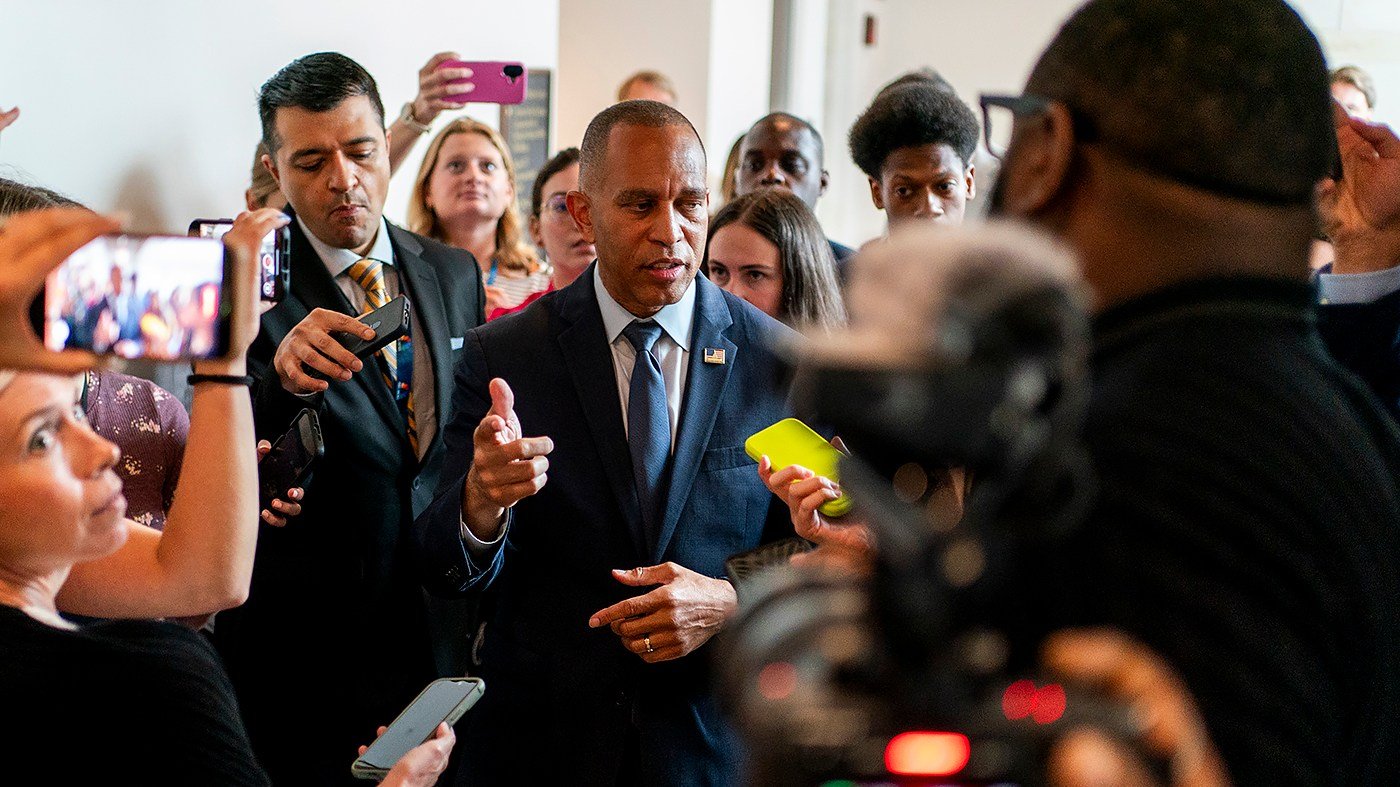
House Democratic leadership is moving to quell the internal uproar triggered this week when two centrist lawmakers crossed the aisle to support a Republican procedural measure. Minority Leader Hakeem Jeffries (D-N.Y.) has shifted from a stern warning to a message of reconciliation, signaling that the party is eager to close ranks with the November midterms looming.
On Tuesday, Jeffries and his top deputies described the votes by Reps. Jared Golden (D-Maine) and Marie Gluesenkamp Perez (D-Wash.) as a “significant breach of trust” that warranted a “significant response.” Some rank-and-file Democrats publicly floated stripping the two of their committee assignments as punishment.

By Thursday, however, Jeffries’s tone had softened markedly. After a one-on-one meeting with Gluesenkamp Perez, he told reporters they had agreed to communicate “in a consistent way where we can arrive at shared priorities.” He praised her as “an important member of the House Democratic Caucus” and a leader of the Blue Dog Coalition, adding, “We value every single member in our caucus — progressives, the New Dems and Blue Dogs — and we’re going to move forward together, in unity, in order to solve problems for the American people.”
The reversal reflects the political calculus facing Democratic leaders. While they want to discourage future defections on procedural votes, they are also acutely aware that Gluesenkamp Perez represents a battleground district that President Trump carried in 2024. Republicans have made her a top target in November, and any public punishment could hand them a powerful campaign weapon.
Golden, who also represents a Trump-won district, is retiring at the end of this term, reducing the immediate political risk for leadership. For Jeffries, who is poised to become Speaker if Democrats retake the House, alienating any member of the caucus ahead of the Speaker vote would be counterproductive.
Jeffries indicated that discussions about potential changes to internal caucus rules would continue, but he suggested there would be no formal sanctions for the defectors. He noted that Gluesenkamp Perez had spoken with Rep. Jim McGovern (D-Mass.), the senior Democrat on the Rules Committee, and that the two “are going to resolve any differences that exist.”
“Because both of them — as is the case with the entirety of the House Democratic Caucus — understand what the stakes are in terms of defeating MAGA extremism in November,” Jeffries said, “and then as Democrats, getting off to a fast start in January.”
The episode has sparked broader debate within the caucus about how to handle members who break ranks. Some Democrats are mulling rule changes to prevent future procedural surprises, but leadership appears to prefer a softer approach as the election approaches.
Jeffries’s pivot also comes amid other distractions, including his recent private meeting with Jared Kushner, which has drawn criticism from progressives like Rep. Alexandria Ocasio-Cortez. The leader’s focus on unity suggests he wants to keep the party’s attention on the November fight, not internal squabbles.