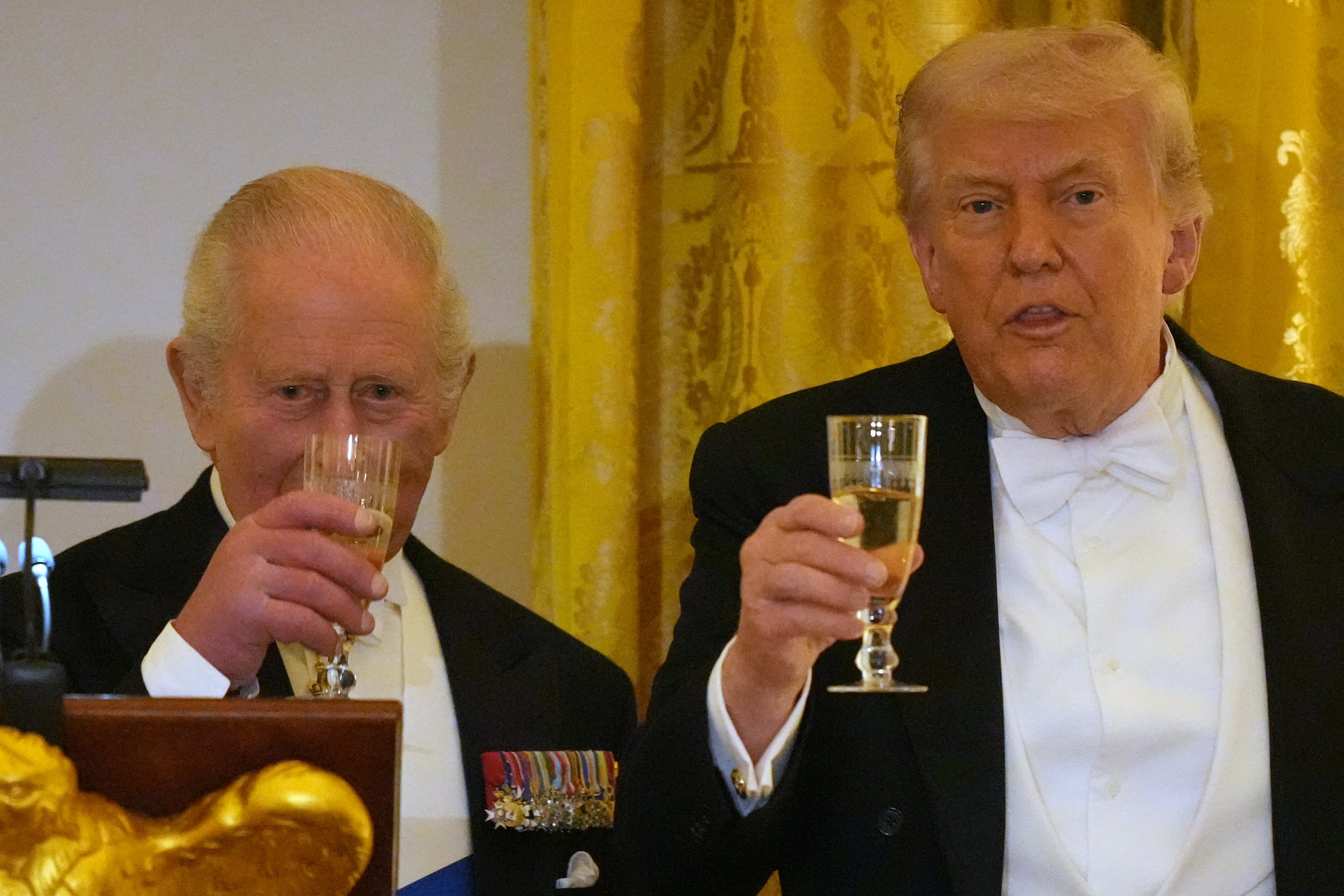
The White House sparked a political firestorm on Tuesday by posting a photo of President Trump and King Charles III with the caption “TWO KINGS” on X, just before the state dinner. It was a clear jab at the “No Kings” protesters who have dogged Trump’s tenure, but the message carried deeper implications as the monarch made a pointed case for transatlantic unity against rising autocracy.
King Charles’s visit, like that of his grandfather King George VI with Franklin Roosevelt in June 1939, comes at a moment of global peril. Then, peace hung by a thread as the king and queen shared hot dogs at Roosevelt’s Hyde Park estate, with democracy under assault from Nazi Germany and Imperial Japan. Today, the Old World faces Russian President Vladimir Putin, while the Kremlin’s allies—China, Iran, and North Korea—threaten the New World.
In a masterful speech to a joint session of Congress, Charles recalled the origins of the U.S.-U.K. special relationship during World War II, even presenting Trump with the bell from the HMS Trump, a T-class submarine. The symbolism was layered: the vessel represented the wartime alliance and the ongoing commitment of the U.K. to the AUKUS security pact in the Indo-Pacific. Charles was echoing Winston Churchill’s urgent calls to Roosevelt, urging action not only against China’s threat to Taiwan but also in Ukraine.
Charles reminded lawmakers that the U.K. and NATO stood with the U.S. after 9/11, during the Cold War, and in Afghanistan. He then called for “unyielding resolve” to defend Ukraine and its “most courageous people.” At the state dinner, he warned that “freedom is again under attack following Russia’s invasion of Ukraine,” framing the fight as the darkest days of the 20th century revisited.
The king also delivered a subtle rebuke to Trump’s monarchical posturing. He told Congress that a president’s true power comes not from titles or gold but from the weight of America’s words and actions, quoting Lincoln at Gettysburg: “The world will little note, nor long remember what we say here, but it can never forget what they did here.” It was a contrast between real royalty’s humility and Trump’s contrived flirtations with monarchy for political show.
This tale of two kings underscores a critical divide. One king is a constitutional figure urging collective action; the other is a populist leader who uses royal imagery to troll opponents. Yet the stakes transcend theatrics. Prevailing in Ukraine is the modern fight for American liberty—lose there, and stopping Xi Jinping in the Indo-Pacific becomes harder. Renewed unity and resolve, as Charles demanded, are essential for NATO and beyond.
Concrete actions matter: sustaining Ukraine with steady munitions, Europe stepping up burden-sharing, and confronting Iran’s nuclear ambitions. Europe cannot repeat the appeasement of 1938 at Munich. The West faces interconnected threats from eastern Europe to Taiwan to the Middle East. Eliminating them is what counts.
Trump’s “Two Kings” stunt aside, the only would-be foreign kings Washington and its allies need fear are Putin and Xi. Charles’s visit was a reminder that real leadership demands deeds, not trolling.