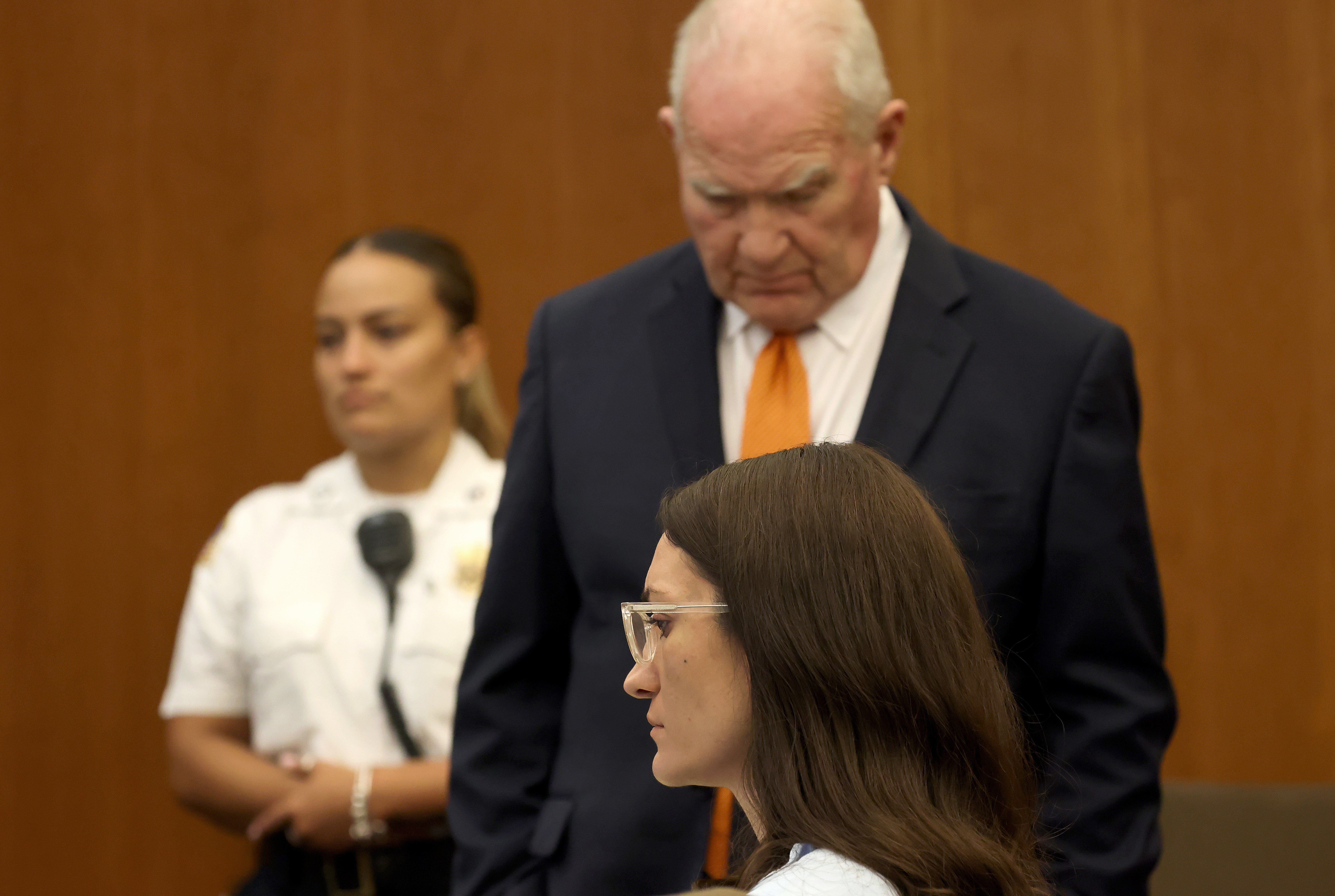
The jury deliberating the fate of Lindsay Clancy, the Massachusetts mother charged with murdering her three children, told the judge on Tuesday that they are deadlocked and cannot reach a unanimous verdict.
Judge William Sullivan instructed the jurors to continue reviewing the evidence and sent them back for further deliberations, according to court reports. The development injects new uncertainty into a case that has drawn intense public scrutiny.

Clancy, 33, faces three counts of first-degree murder in the deaths of her children—5-year-old Cora, 3-year-old Dawson, and 8-month-old Callan—who were found strangled with exercise bands in the basement of the family's Duxbury home in January 2023. Prosecutors say she then attempted suicide by jumping from a second-story window, an act that her attorneys say left her paralyzed from the waist down.
What happens if the jury remains deadlocked?
Under Massachusetts law, a hung jury—when jurors cannot agree unanimously on a verdict—can lead to a mistrial. The judge has the discretion to keep the jury deliberating for as long as he deems reasonable. If the foreperson again reports an impasse, the judge may declare a mistrial, effectively ending the trial without a verdict.
Once a mistrial is declared, the prosecution decides whether to retry the case before a new jury. They could also negotiate a plea agreement with the defense. The defense, led by attorney Kevin Reddington, has argued that Clancy was suffering from postpartum psychosis and should not be held criminally responsible for the killings. Under state law, a defendant is not guilty if they lacked criminal responsibility at the time of the offense.
The prosecution's burden was to prove beyond a reasonable doubt that Clancy did not have a mental disease or defect, or that even if she did, she retained the substantial capacity to appreciate the wrongfulness of her conduct and to conform her behavior to the law.
A recent precedent: Karen Read's hung jury
The case echoes another high-profile Massachusetts murder trial that ended in a hung jury. Karen Read, accused of killing her boyfriend, Boston Police Officer John O'Keefe, with her car and leaving him to die in a snowstorm, saw her first trial end without a verdict after 20 hours of deliberation. She was later retried and found not guilty.
Read's case, like Clancy's, highlighted the difficulty of reaching unanimous verdicts in emotionally charged trials. Legal experts say the outcome in Clancy's case will hinge on whether the jury can find common ground on the question of her mental state at the time of the killings.
As the jury continues its work, the courtroom in Plymouth Superior Court remains tense. The judge's instruction to keep deliberating is a common step to encourage a verdict, but the possibility of a mistrial looms. If that happens, the case could drag on for months or years, prolonging the ordeal for all involved.
For now, the public waits. The case has sparked debates about postpartum mental health and criminal responsibility, with advocates for maternal mental health closely watching the proceedings. A retrial, if necessary, would likely draw renewed attention to these issues.