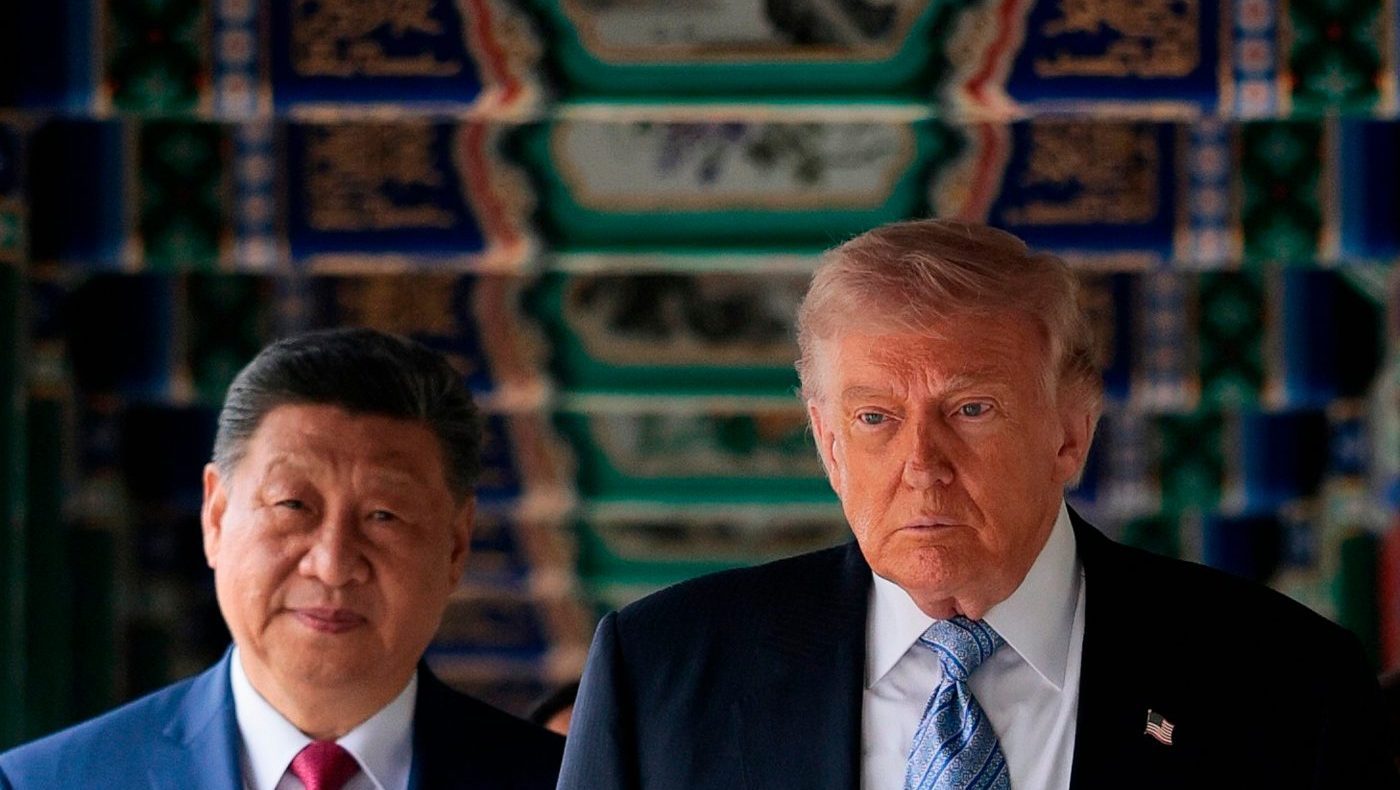
Existential warnings about the dangers of unregulated artificial intelligence are injecting fresh urgency into next week's meeting between President Trump and Chinese President Xi Jinping in Washington. The two leaders are scheduled to sit down on Sept. 24, and while trade, Taiwan, and technology transfers remain the usual heavyweights, AI governance has now muscled its way onto the agenda.
Trump has repeatedly dismissed AI's doomsday scenarios as a "hoax," a stance that analysts say largely mirrors Beijing's own dismissive attitude toward such alarms. But the persistent rivalry and mutual suspicion between the two capitals have so far prevented any substantive U.S.-China discussions on AI safeguards or regulations.

Recent high-profile warnings from the American tech sector, including calls to pause development until safety measures catch up, have pushed the issue higher on the bilateral agenda. Treasury Secretary Scott Bessent told Axios this week that he is open to discussing "shared risks" around AI with Beijing, and Trump confirmed to reporters on Friday that AI would be among the topics on the table.
China, for its part, has its own reasons to worry. The country's top intelligence official published an unusually blunt article last week warning that AI could directly threaten the Communist Party's grip on power—a rare public acknowledgement in a tightly controlled media environment.
"We're at a point where both the United States and China appear to agree on some of the risks posed by AI, particularly around issues of cyber capabilities and loss of control," said Alison Szalwinski, a senior vice president at The Asia Group. "The challenge is that there's some really significant disagreements on how to manage those risks, and whether AI governance can be separated from the broader strategic U.S.-China competition."
Expectations for concrete breakthroughs are low. The May summit in Beijing was widely seen as light on substance, and analysts doubt this meeting will produce anything more than a possible framework for continued dialogue. "At this point, the immediate goal is less about negotiating a major AI agreement—we're just not there yet—and more about establishing a durable channel for discussing frontier AI risk," Szalwinski added.
One key U.S. concern is the development of advanced AI in frontier labs, which could theoretically break free from human control and cause catastrophic harm, such as autonomous weapons deployment or critical infrastructure shutdowns. In a recent social media post, an AI researcher claimed that many developers believe the technology could end humanity by the decade's close. Days later, Anthropic CEO Dario Amodei urged major AI companies to commit to slowing development so safety regulations can keep pace—while also insisting that the U.S. must maintain its edge over China, accusing Chinese firms of "distillation," or using American models to accelerate their own development.
Beijing bristled at such characterizations. "Fear-mongering, confrontation and vicious competition will only hamper efforts toward sound global AI governance, which serves no one's interest," said Guo Jiakun, a Chinese Foreign Ministry spokesperson. He added that all parties should "jointly promote the open and inclusive development of AI for good and for all."
That position may align more closely with Trump's own instincts, according to Kyle Chan, a fellow at the Brookings Institution's John L. Thornton China Center. "I don't think that Trump is feeling any pressure about the existential AI risk issue. He calls it a hoax multiple times. It reminds me very much of how he treats climate change," Chan said. "I think his primary concern is keeping the AI boom going, keeping the stock market going, keeping the data center boom going."
Still, Bessent's interest in AI discussions could open a door. A key question is whom Xi will designate as his counterpart for such talks—whether it's Ding Xuexiang, China's tech industrial czar; the head of the National Development and Reform Commission (NDRC); or officials from the Cyberspace Administration (CAIC). "Depending on which of those two would send a different signal," Chan noted. "The NDRC head has been involved in investment talks and joint AI development talks with other countries... CAIC would be a signal about a more serious discussion about AI regulation and safety."
Even if a channel is established, agreeing on what to discuss is another hurdle. In 2024, former President Biden and Xi agreed that humans—not AI—should control nuclear weapons, a directive later written into federal law. Democrats are now pressing Trump to raise that commitment with Xi next week, and Representative Ro Khanna (D-Calif.) has been among those urging the administration to prioritize AI safety in the bilateral relationship. As criticism of Trump's AI deregulation approach grows, the summit may test whether Washington can move beyond rhetoric to establish a working dialogue on one of the most consequential technological challenges of the era.