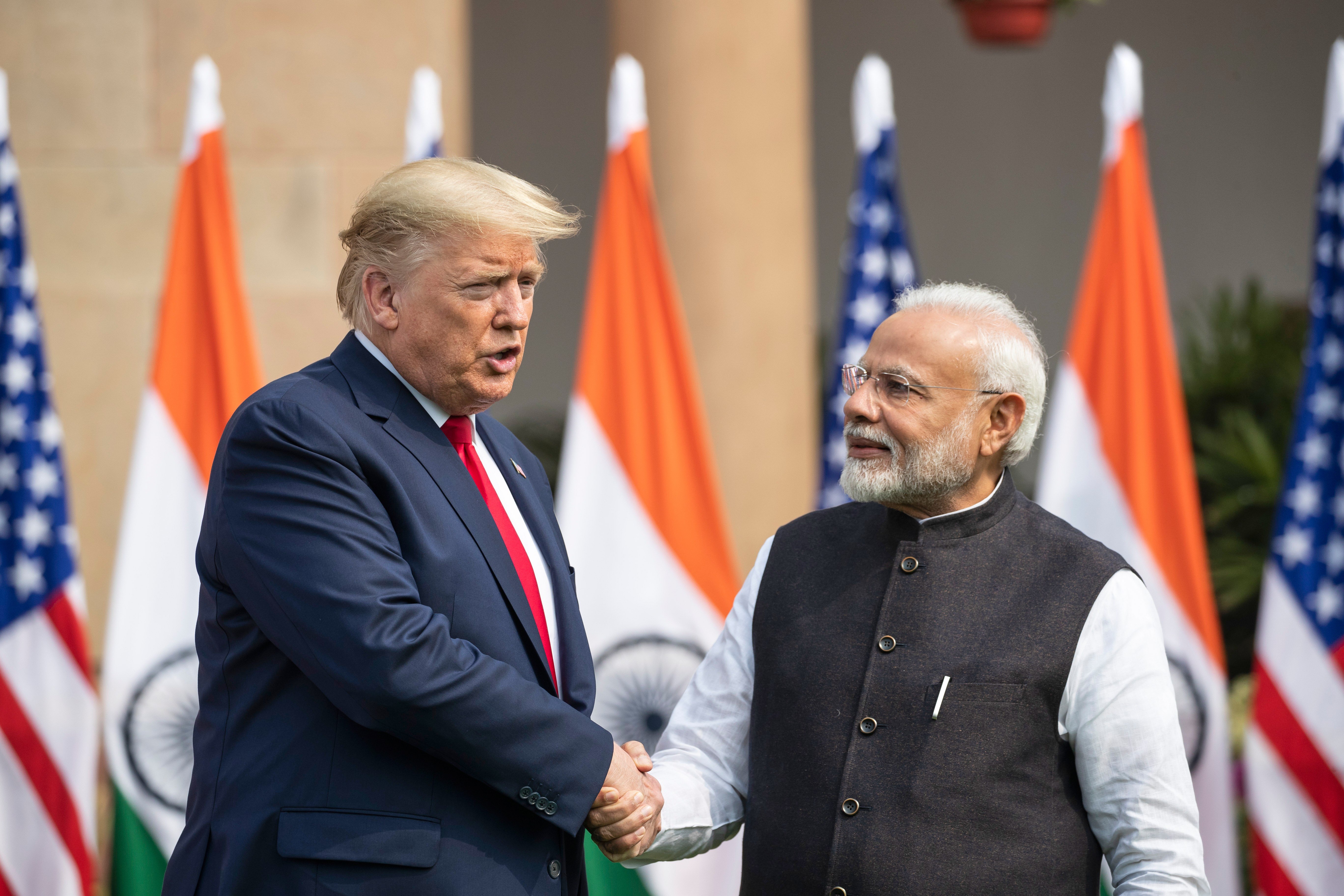
Washington's experience with Beijing has fundamentally altered how it views India's ascent. Having once championed China's economic rise only to face a formidable strategic rival, the U.S. is now determined not to repeat that pattern with New Delhi.
Deputy Secretary of State Christopher Landau made that clear during his visit to New Delhi earlier this year. He bluntly stated that America would not allow India to "develop all these markets" and capabilities, only to find India "beating us in a lot of commercial things." His remarks reflect a broader reassessment of India's role in U.S. strategy.

Two months before Landau's comments, the State Department's five-year strategic plan made only a single mention of India, saying Washington would "seek partnership with growing regional economies such as India but on terms that advance U.S. security and economic interests and avoid repeating past mistakes." That's a stark departure from the previous two decades, when a rising democratic India was seen as an unalloyed good—a counterweight to an autocratic China and a lucrative market for American firms.
The shift is structural, not just rhetorical. President Trump's National Security Strategy downgrades India to a passing reference, and the Pentagon's 2026 National Defense Strategy omits India entirely, despite New Delhi conducting more annual military exercises with the U.S. than any other country. In June, the Pentagon even dropped the "Indo" prefix from "Indo-Pacific," a symbolic but telling change.
This downgrade is also weakening the Quad, the strategic coalition of the U.S., India, Japan, and Australia. No Quad leaders' summit has been held since 2024, and Trump's trade war with India derailed last year's planned meeting. The grouping now gets just a single mention in Trump's National Security Strategy, tied only to India.
Many in India's strategic establishment still view Trump as an aberration—a disruptive president whose tariffs and transactional tactics will pass, allowing a return to the pre-Trump trajectory. But that assumption mistakes a presidential interlude for a structural shift. The deeper change in Washington's thinking began in the latter half of Joe Biden's presidency, as disagreements over trade, South Asia policy, and India's neutrality on the Ukraine war mounted. Trump has accelerated the shift and stripped away the diplomatic cushioning that once softened bilateral friction.
India, however, is no longer a weak power the U.S. can shape. Its economy has nearly quadrupled in real terms since 2000, and it has its own industrial ambitions, energy strategy, and geopolitical relationships. Like every major power, India seeks to preserve its strategic autonomy—a principle Washington itself upholds. The tension lies not in autonomy per se, but in the conflict between Washington's expectation that India's rise should serve U.S. objectives and New Delhi's determination that its growing power expands, not narrows, its freedom of action.
Bilateral trade talks are currently deadlocked. India wants to become a manufacturing powerhouse and reduce external dependence, while the U.S. seeks greater access to India's vast domestic market. These tensions are manageable, provided Washington doesn't mistake partnership for alignment and India doesn't confuse strategic autonomy with defiance.
The renewed China analogy is instructive: Washington's lesson is not that India's rise must be stopped, but that the terms of U.S. assistance matter. Secretary of State Marco Rubio is scheduled to visit India next week, his second trip in five months, signaling continued engagement even as the strategic rebalancing proceeds.
Ironically, China is also acting to constrain India's rise, imposing export curbs on manufacturing equipment and industrial components to slow India's emergence as an alternative global hub. As Washington recalibrates, it must navigate not only its own lessons from China but also the competitive dynamics between Beijing and New Delhi.