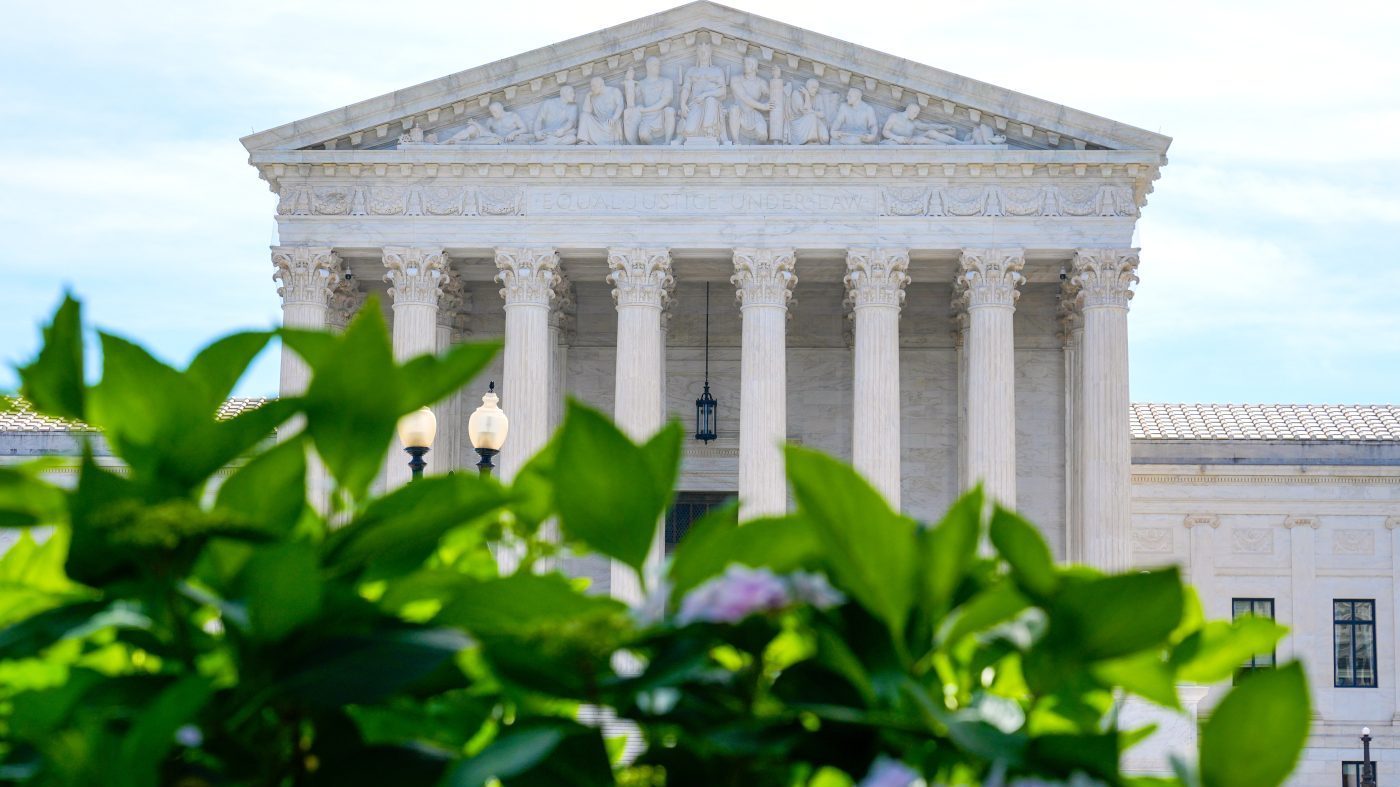
The Supreme Court announced Monday that it will take up a dispute over the admissions system at a competitive middle school in Montgomery County, Maryland — a case that could clarify how far school districts can go to promote racial diversity following the justices' 2023 decision that struck down affirmative action in higher education.
The case, brought by the Association for Education Fairness, a group representing Asian-American parents, challenges the county's two-step process for selecting students for its magnet programs in STEM and the humanities. Under the policy, which was introduced during the COVID-19 pandemic, students are initially screened based on grades and test scores. Those who pass that threshold are then entered into a lottery, with the winners receiving seats.
The parents' group argues that the policy, though facially race-neutral, violates the Constitution's equal protection guarantee because it was designed to limit the number of Asian-American students admitted. Lower courts dismissed the suit, ruling that the plaintiffs had not provided sufficient evidence of discriminatory intent.
The association now wants the Supreme Court to establish a uniform national standard for what evidence is required to prove that a race-neutral policy is discriminatory in practice. “The governing constitutional standard now depends on geography,” the group's lawyers wrote in their petition. “Evidence sufficient to establish an Equal Protection claim in some circuits is legally irrelevant in others.”
The case will be argued in the current term, with oral arguments likely next year and a decision expected by June. The Montgomery County school board has pushed back, calling the case “unremarkable and of little significance” and arguing that it is not the appropriate vehicle for setting broad precedent. “This case involves a race-neutral lottery adopted in response to a global pandemic,” the board's lawyers wrote. “It is not the right fact pattern for this Court to take up the question presented.”
The high court's decision to hear the case follows a series of similar appeals in the wake of its 2023 affirmative action ruling. Last year, the justices declined to review a challenge to a revised admissions policy at Thomas Jefferson High School for Science and Technology in northern Virginia, one of the nation's top-ranked high schools. Justices Samuel Alito and Clarence Thomas, both conservatives, publicly dissented from that decision. “The Court's willingness to swallow the aberrant decision below is hard to understand,” Alito wrote at the time.
Months later, the same two justices dissented when the court refused to intervene in a fight over admissions at Boston's elite “exam schools.” The new case, however, gives the court an opportunity to weigh in more broadly on the evidentiary standard for race-neutral policies that have a disparate impact.
Legal experts say the outcome could have significant implications for school districts across the country, as many have adopted similar lottery-based or race-neutral mechanisms to diversify their selective programs. The case also touches on the ongoing national debate over how to achieve educational equity without running afoul of the Constitution's colorblind mandate.
This is not the first time the Supreme Court has grappled with the intersection of race and education. In a related development, lower courts have recently been asked to weigh in on other contentious school policies, including transgender student policy lawsuits and challenges to the Education Department's stance. Meanwhile, the court is also set to hear a separate dispute over video privacy law and newsletter tracking, which could have broader implications for digital privacy.
As the case proceeds, both sides will be watching closely. The parents' group has argued that the Supreme Court must step in to provide clarity, while the school board maintains that its policy is lawful and necessary to address historical inequities. The eventual ruling could reshape how schools across the nation design their admissions processes.