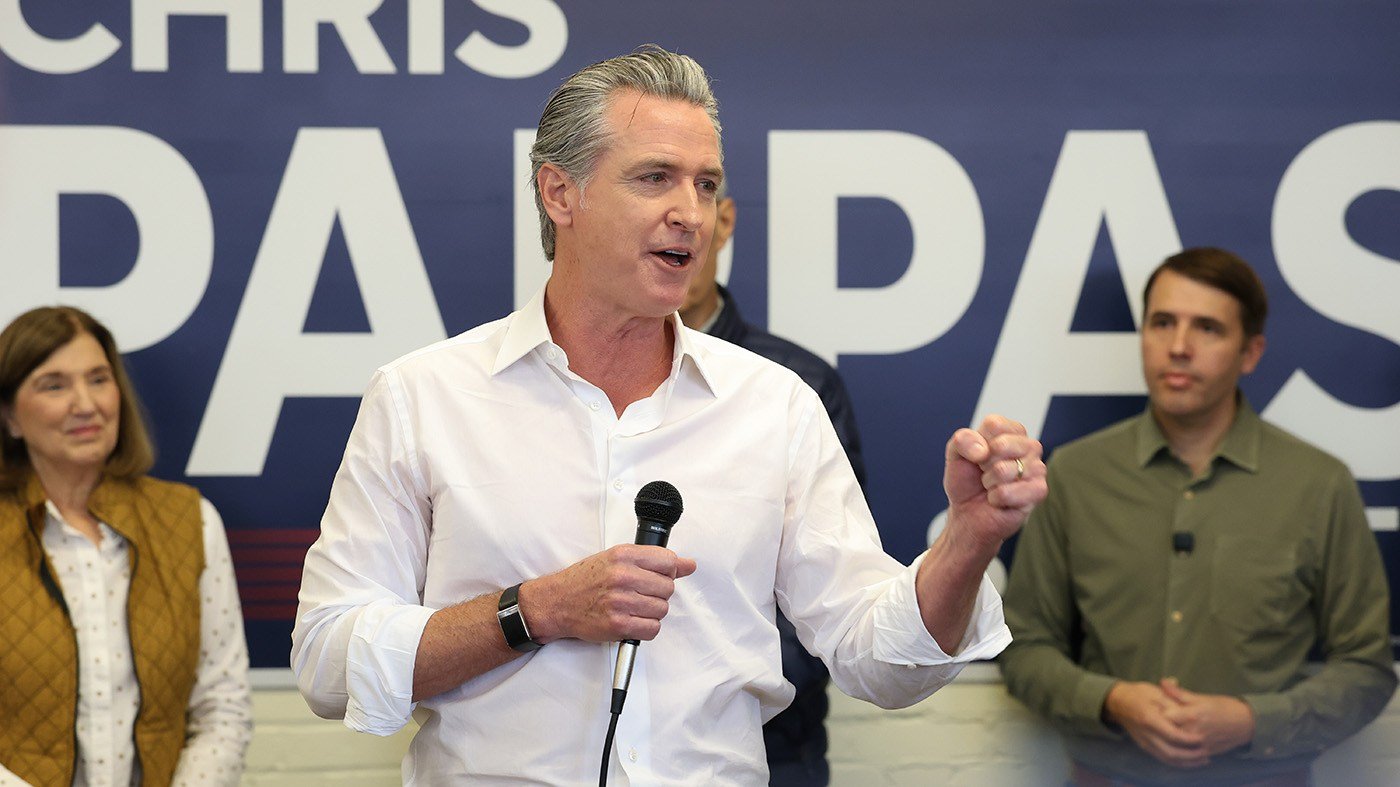
California Governor Gavin Newsom has quietly assembled a formidable small-dollar fundraising and organizing operation that could give him a distinct advantage if he enters the 2028 presidential race, a prospect many Democrats view as increasingly likely. His network, built on a sprawling email list of supporters nationwide, has already raised millions this cycle, positioning him as a top contender before any formal announcement.
Newsom's team reports that his list, which surpassed 17 million addresses even before last year's Proposition 50 redistricting push, has grown exponentially since. That effort, which drew heavy Democratic donations to redraw California's electoral maps, supercharged his digital outreach. While advisers declined to disclose the current list size, its impact is clear: more than $6.8 million has been raised during the midterm cycle, fueled by over 305,000 contributions averaging just $22.47 each.
The governor's fundraising appeals have largely been directed toward other Democratic candidates and causes, with $1.85 million going to 15 state Democratic parties and $2.2 million to Southern Democrats to build infrastructure in the Deep South—a region where the party has struggled recently. Newsom's team emphasizes his focus on midterm victories, but the infrastructure being built now could seamlessly pivot to a presidential campaign.
Political strategists see this as a key edge. "Oh, of course, that's a key advantage he'll have in a presidential race," said Garry South, a longtime Newsom ally who advised his first gubernatorial campaign. "First, any successful candidate in California starts out with a bigger donor base than anyone from another state because we're the biggest state. But his national fundraising for Prop 50 provides him with a national fundraising base on top of his proven California donor list."
Newsom's list-building began in earnest during the 2021 recall attempt, when he had just 250,000 contacts. By 2022, Politico reported it had grown to 6 million, and after hiring Tim Tagaris, who managed Bernie Sanders' 2016 digital operation, it became a potent political weapon. Tagaris helped transform the list into a tool for rapid response and fundraising, often targeting fights with Trump and Republicans on contentious issues.
In the 2024 cycle, Newsom's apparatus poured more than $21 million into Democratic efforts, demonstrating its scale. Other potential 2028 contenders, like Rep. Alexandria Ocasio-Cortez (D-N.Y.), have also built strong small-donor operations—she raised over $37 million this cycle, mostly from contributions under $200, and had $17 million cash on hand by September. Ocasio-Cortez is weighing a presidential bid or a Senate run, and her fundraising strength keeps her in the conversation.
The role of money in politics has evolved, with candidates using small-dollar donations to signal grassroots support. "Money's important but not determinative—just look at the literal billions the GOP is spending on midterm races, and still failing to close the gap," said Democratic strategist Christy Setzer. "Money can buy name recognition but also a negative label from voters, who generally hate self-funders and the way money is so infused in our politics." Setzer added that "a large amount of small dollar donations, however, are important as a show of strength and momentum; it's a key reason AOC is mentioned in 2028 conversations."
Newsom's appeals are constant but targeted, often highlighting red-state candidates. In August, he sought support for former Rep. David Jolly in Florida and Jermaine Johnson in South Carolina. "We've raised a lot of money for southern states and candidates running in southern states this year, and there's a good reason for it," Newsom wrote in an email. "These are places long-neglected by the Democratic Party." He added, "The only way back for those states is if we have the courage to fight—cycle after cycle—until we get it done."
The investments have tangible effects, particularly in early primary states. In New Hampshire, Newsom raised over $579,000, funding a new Democratic field office in Nashua. In South Carolina, the first Democratic primary state, his list raised more than $342,000 for the state party, $53,000 for gubernatorial candidate Johnson, and over $61,000 for six state House candidates. These moves not only help Democrats now but also build goodwill and infrastructure that could prove crucial in a 2028 campaign.
As the midterms approach, Newsom's operation stands as a model of modern political fundraising—one that could easily pivot from helping others to powering his own White House ambitions. For now, his team insists the focus remains on November, but the foundation being laid is unmistakably presidential.